

Backlinks are still one of the strongest signals of trust and authority in search—and in today’s fast-evolving SEO landscape, how we approach them matters more than ever.
As algorithms become more intelligent, backlinks have moved beyond being just a ranking shortcut. They now play a deeper role in how search engines measure credibility, topic relevance, and user value.
This guide breaks down what makes a backlink valuable, the different types of backlinks, and where your focus should be to build long-term authority and performance.
What Are Backlinks?
A backlink, also as defined by BACKLINKO is a hyperlink from one website to another. When another website links to yours, it signals to search engines that your content is credible and worth referencing.
But here’s the key: Not all backlinks are equal. A few high-quality, well-placed links can outperform dozens of low-value ones.
Why Backlinks Still Matter Today
Despite advancements in AI and semantic search, backlinks continue to:
-
Strengthen your website’s trust and authority
-
Help search engines discover and index your content
-
Improve your chances of ranking for competitive keywords
-
Drive referral traffic from relevant audiences
-
Support visibility in both general and local search results
But for backlinks to truly support your growth, they need to be earned with intention—not volume.
What Makes a Backlink Valuable Today?
In 2025 and beyond, a valuable backlink has these core characteristics:
1. Topical Relevance
The linking website should be contextually related to your industry or niche.
Relevance is more important than a generic high domain authority score.
2. Contextual Placement
Links placed naturally within high-quality content are more powerful than those hidden in footers, sidebars, or bios.
3. Indexability
If the page linking to you is not indexed by Google, the backlink won’t pass any SEO value.
4. Traffic and Engagement
Links from pages that users visit, read, and engage with send stronger signals to search engines than links on low-traffic pages.
5. Trust and Editorial Integrity
Links that are editorially placed or genuinely earned (not forced or bought) carry more weight and stand the test of time.
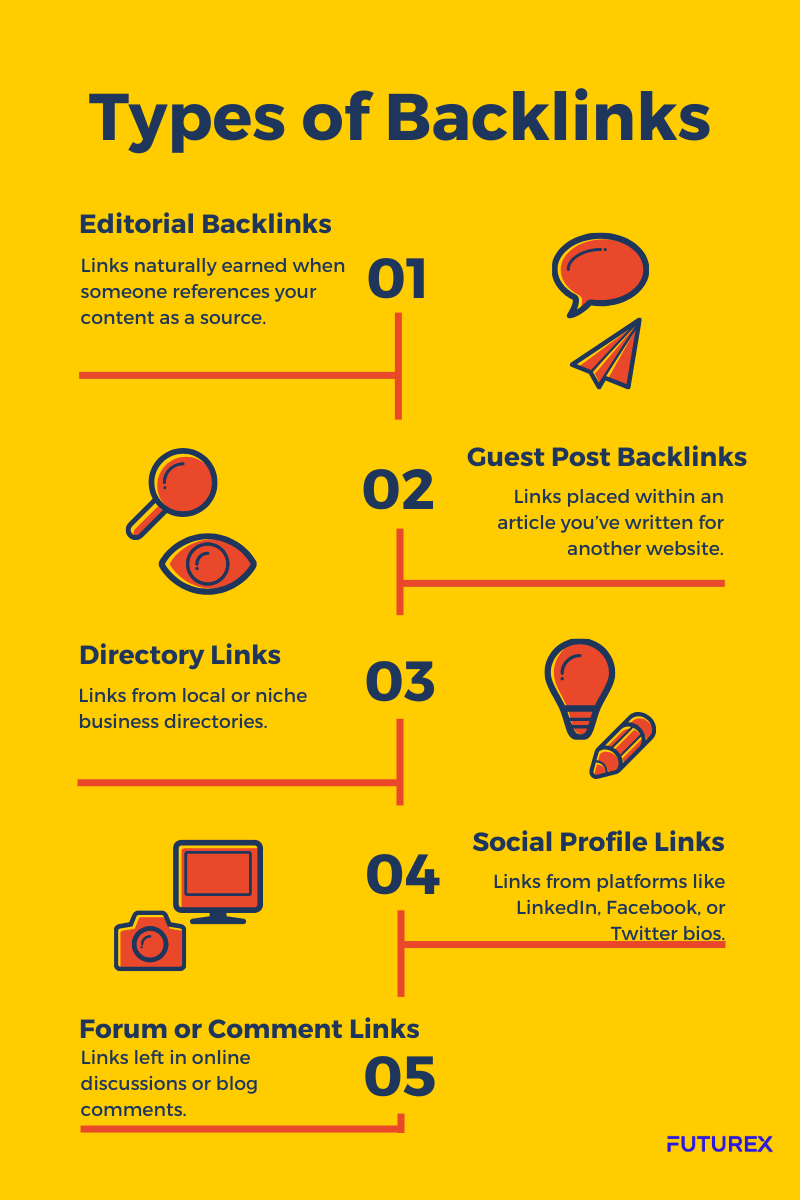
Types of Backlinks – And What They Mean for Your Strategy
Understanding the different types of backlinks can help you focus your efforts where they’ll be most effective:
Editorial Backlinks
Links naturally earned when someone references your content as a source.
🟢 High value – signals organic authority and trust.
Guest Post Backlinks
Links placed within an article you’ve written for another website.
🟢 Valuable – if placed in-context, on quality platforms, and with a purpose beyond SEO.
Directory Links
Links from local or niche business directories.
🟡 Useful for local SEO – when sourced from trusted, human-reviewed platforms.
Social Profile Links
Links from platforms like LinkedIn, Facebook, or Twitter bios.
🔵 Supportive for indexing and discovery – but offer little ranking value on their own.
Forum or Comment Links
Links left in online discussions or blog comments.
🔴 Low value – and risky if overused or on unmoderated forums.
Sponsored Backlinks
Paid or advertorial links that must be disclosed (rel=”sponsored”).
🟡 Acceptable if transparent and relevant – but shouldn’t be your main strategy.
Resource Page or Tools Links
Links from curated lists of tools, templates, or helpful content.
🟢 High long-term value – especially when tied to a strong lead magnet or unique asset.
The Best Types of Websites to Get Backlinks From
To build backlinks that actually support SEO, focus on websites that are:
Relevant to Your Industry or Niche
-
B2B blogs
-
Trade publications
-
Sector-specific platforms
Authoritative & Trustworthy
-
Business media (local or national)
-
Respected niche blogs
-
Partner platforms with established audiences
Part of Your Local or Professional Ecosystem
-
Local directories
-
Chamber of commerce websites
-
Professional associations
Open to Collaborations
-
Guest posting opportunities
-
Expert roundups
-
Podcast or webinar hosts
Indexable and Active
-
Always check that the linking site and page are indexed by Google and consistently updated.
What to Avoid
To protect your domain authority and ranking potential, avoid:
-
Low-quality, spammy directories
-
Automated link-building schemes
-
Link farms or PBNs (private blog networks)
-
Overuse of exact match anchor text
-
Unindexed or low-traffic pages with no engagement
Backlinks and the Future of SEO
As AI and user-intent-based ranking systems evolve, backlinks are shifting from quantity-based metrics to signals of genuine trust and relevance.
In short: Google is less interested in how many sites link to you—and more interested in who, why, and where.
How FutureX Supports Strategic Backlink Growth
At FutureX, we help businesses move beyond outdated link-building tactics.
We focus on building authority through:
-
Auditing and cleaning up existing backlinks
-
Identifying high-trust, niche-specific opportunities
-
Creating valuable content assets worth linking to
-
Building long-term digital partnerships
Our approach isn’t about volume. It’s about building trust and results—sustainably.
Read More
How to Earn High-Quality Backlinks Without Cold Outreach or Spam Tactics