

How AI Tools Recommend Real Estate Companies in Kenya: A Mini Study on Digital Visibility and Trust
AI is slowly changing how people discover real estate companies in Kenya.
Buyers are no longer only searching on Google, scrolling through social media, checking property platforms, or asking for referrals. They are also asking AI tools for help when comparing real estate agents, property developers, and companies they can trust.
A buyer may ask how to know if a real estate company in Kenya is trustworthy, which companies are considered reliable, how to avoid real estate scams, or which real estate agents in Nairobi are worth considering.
These questions show how real estate discovery is changing. A potential buyer may not visit your website first. They may first ask an AI tool which companies to consider, which property developers look credible, or what signs to check before buying land or an apartment.
That means digital visibility for real estate brands is no longer only about ranking on Google.
It is also about whether AI tools can find, understand, and confidently describe your brand.
What We Tested
At FutureX, we ran a mini study to understand how AI tools respond to real estate-related discovery queries in Kenya.
We tested 15 prompts across five AI discovery environments: ChatGPT, Gemini, Copilot, Meta AI, and Google AI Overview.
This produced 75 primary searches.
The prompts were grouped into three categories: informational, commercial, and transactional.
The informational prompts focused on buyer trust, due diligence, fraud prevention, and how users evaluate real estate companies before making a decision. These included questions such as how to know whether a real estate company in Kenya is trustworthy, what to check before buying land, how to avoid real estate scams, what documents to verify before buying property, and how to choose a reliable property developer in Nairobi.
The commercial prompts looked at comparison and recommendation queries. These included searches around the best real estate companies in Kenya, the most trusted real estate companies in Nairobi, the best property developers in Kenya, reliable real estate agents in Nairobi, and real estate companies in Kenya with good reviews.
The transactional prompts focused on stronger buying intent. These included searches around apartments for sale in Nairobi from trusted developers, land for sale near Nairobi from reputable companies, off-plan apartments for sale in Nairobi, property management companies in Nairobi, and real estate companies offering payment plans in Kenya.
Google AI Overview was included because it reflects passive AI exposure inside normal Google search results. Unlike chatbot tools, AI Overview only appears when Google chooses to generate one for a query.
In two cases where Google AI Overview did not appear, Google AI Mode was checked as a fallback reference. However, it was not included as a primary platform in the main comparison.
What We Looked For
For each AI response, we recorded which real estate brands were mentioned, where they appeared in the answer, whether they were directly recommended or only mentioned as examples, and whether the AI tool cited any sources.
We also looked at the websites or references used, how locally relevant the answer was to Kenya, and whether the response gave any clear reason for trusting or choosing a company.
For Google AI Overview, we only recorded results when an AI Overview appeared. If it did not appear, the result was marked as “No AI Overview triggered.”
For Copilot, we focused on the main answer and the references used in the chat. Related searches were treated as search-intent signals, not as brand recommendations.
The aim was not just to see which real estate companies appeared most often. The aim was to understand what kind of digital footprint seems to support visibility in AI-generated answers.
What the Brand Mentions Show
From the preliminary findings, some real estate brands appeared more visibly than others across AI-generated responses.
After consolidating obvious brand name variations, Optiven Group had the highest number of mentions, with 43 appearances across the study data. It was followed by Kings Developers with 40 mentions, HassConsult with 37, Username Properties with 33, Centum Real Estate with 29, and Knight Frank Kenya with 28.
Pam Golding Properties Kenya also appeared strongly, with 21 mentions, while Fanaka Real Estate, Two Rivers, AMG Realtors, Tatu City, Finsco Africa, BuyRentKenya, Impala Developers, Gazebo Homes, and Villa Care appeared in the next tier of visibility.
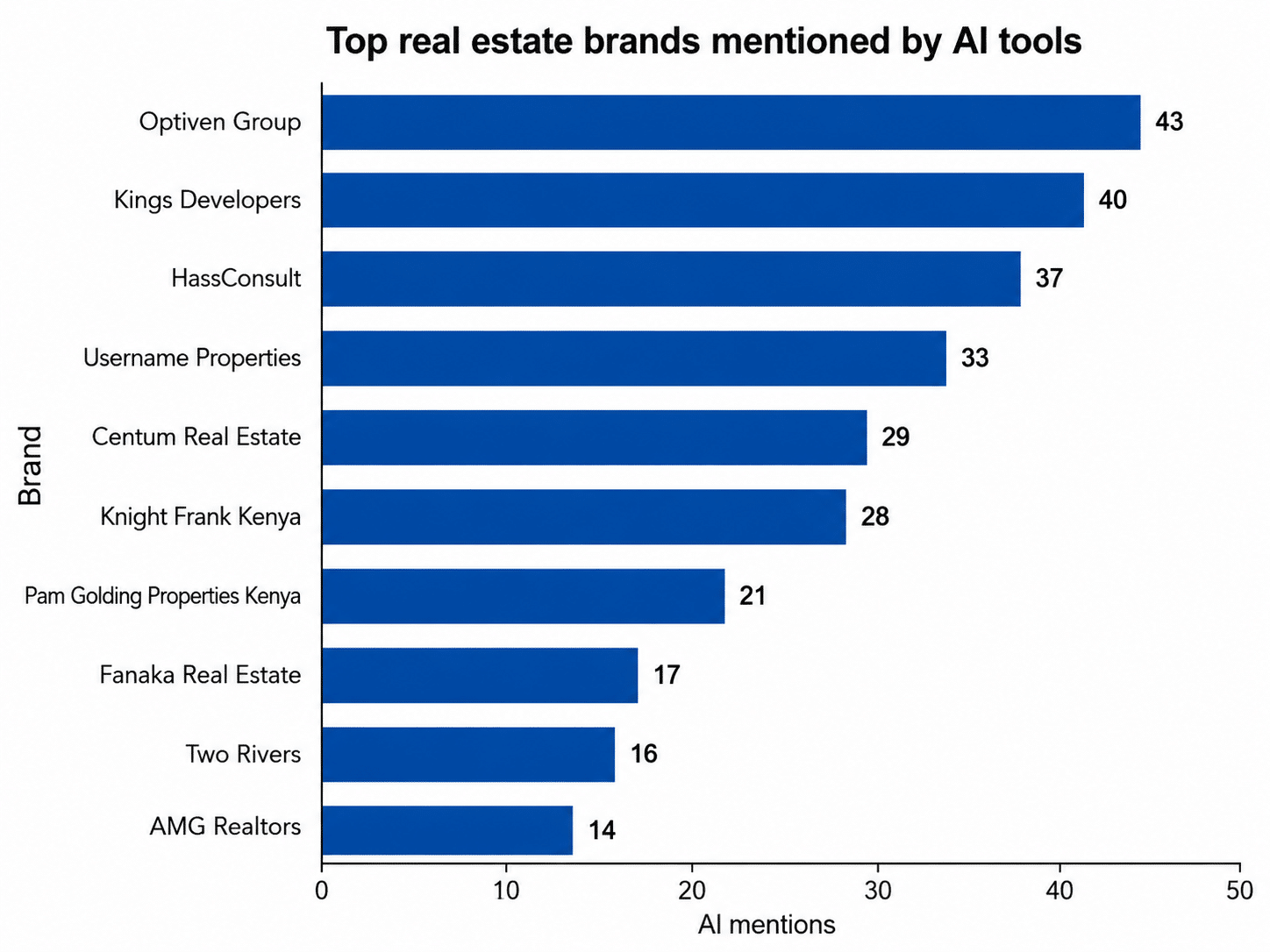
This does not mean these are automatically the best real estate companies in Kenya. It means they were more visible in the AI responses we tested.
That distinction matters.
AI visibility is not the same as AI endorsement. A brand may appear because it has a stronger public footprint, because it is cited by third-party sources, because it has recognizable projects, because it appears in property-related lists, or because the AI tool has enough public information to describe it confidently.
For example, Optiven’s visibility across the study may be linked to the fact that the brand appears across multiple AI environments and has a wider public footprint than smaller or less-documented real estate companies. Kings Developers, HassConsult, Username Properties, Centum Real Estate, Knight Frank Kenya, and Pam Golding Properties Kenya also appeared across several prompts and platforms, suggesting that AI tools are more likely to surface brands that already have stronger public recognition, structured online information, or third-party references.
The practical lesson is clear: if AI tools cannot find enough clear and credible information about your brand, they may struggle to mention you when buyers ask for recommendations.
For real estate companies, this makes digital visibility more complicated than simply having a website or posting on social media. AI tools need signals they can interpret. Those signals may come from your own website, but they may also come from property platforms, directories, media articles, industry lists, reviews, legal resources, and other public references.
What the Cited Sources Show
The cited-source data was just as important as the brand mentions.
Across the study, the cited sources showed that AI tools do not rely on one type of source when responding to real estate questions. They pulled from company websites, project pages, property platforms, directories, media articles, list-based pages, legal resources, government or regulatory sources, social platforms, and finance-related sources.
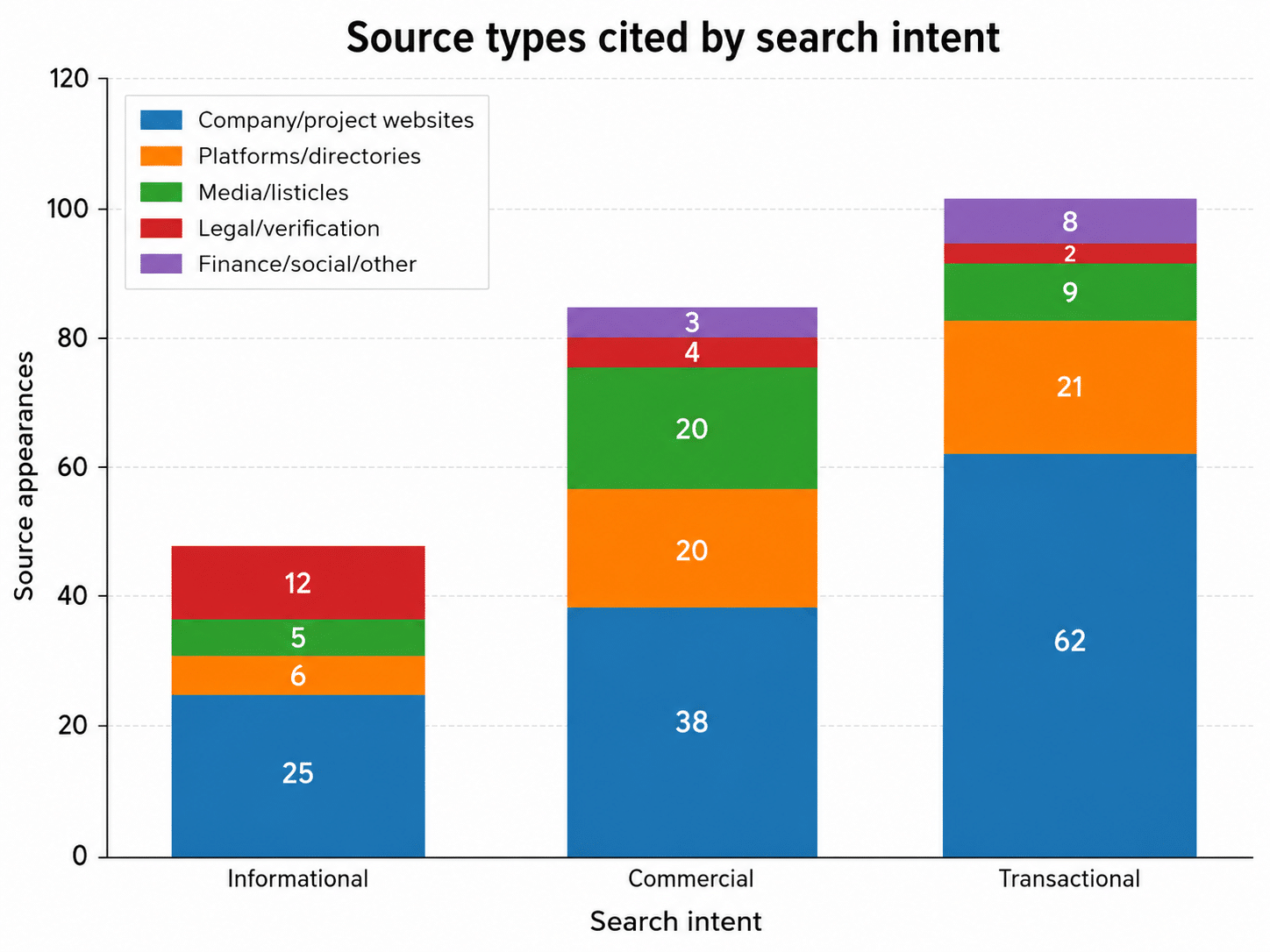
After grouping and deduplicating repeated domain appearances within the same platform and prompt, we recorded 235 source appearances across the cited-source data.
Company and project websites were the largest source category, with 125 source appearances. Property platforms and directories followed with 47. Media articles, listicles, and industry blogs accounted for 34. Legal, regulatory, and verification-related sources appeared 18 times. Finance, social, search, and other web sources made up the remaining source appearances.
This matters because real estate companies often assume their website or social media page is enough.
But AI tools may be reading a wider public footprint. If a company has a weak website, limited third-party mentions, inconsistent business information, or very little helpful content online, there may be fewer signals for AI tools to use when generating answers.
The source patterns also changed depending on search intent.
For informational prompts, the responses leaned more toward trust and verification. These included legal, regulatory, due diligence, title search, land ownership, company verification, and fraud-prevention sources. This makes sense because the user is not yet looking for a specific project or company. They are trying to understand how to avoid risk.
For commercial prompts, the responses leaned more toward company websites, media listicles, property platforms, directories, and pages comparing real estate companies, agents, or developers. This is where visibility in “best,” “top,” “trusted,” and “reviewed” lists can influence what AI tools surface.
For transactional prompts, the sources moved closer to company and project websites, property listing platforms, apartment pages, land-sale pages, off-plan project pages, payment-plan pages, and property management service providers. This is where real estate companies need strong landing pages, clear project pages, updated listings, payment-plan information, and enough supporting detail for buyers and AI tools to understand the offer.
This suggests that AI discovery is not one uniform behaviour. The sources AI tools use can shift depending on whether the user is learning, comparing, or ready to act.
Why AI Discovery Matters in Real Estate
Real estate is a high-trust industry.
Buyers are not just looking for listings. They are looking for signs that a company is legitimate, reliable, transparent, and capable of helping them make a safe decision.
This is especially important in Kenya, where buyers may be cautious about fraud, unclear ownership, poor communication, delayed projects, misleading property information, or unverified agents.
So when an AI tool recommends or mentions a real estate brand, the real question is not only whether that brand appeared. It is also what public signals may have made the brand visible in the first place. That could include the company website, search visibility, Google reviews, third-party mentions, directory listings, social media consistency, or content that helps answer buyer questions.
This is where AI and real estate marketing start to overlap. AI tools do not simply respond to what a company says about itself. They may also rely on visible public signals across search results, websites, citations, reviews, and other online sources.
A real estate company may be active on social media, but if its website is thin, its project pages are unclear, its business information is inconsistent, and its brand has few credible mentions elsewhere, AI tools may have limited information to work with.
That matters because AI tools are increasingly becoming part of the buyer’s discovery journey.
A buyer may use AI to shortlist companies before visiting websites. They may use it to compare developers before booking a site visit. They may use it to understand whether an offer sounds legitimate before filling out a form or sending a WhatsApp message.
If your brand is not visible in those moments, you may not even enter the buyer’s consideration set.
Early Observations from the Study
One of the clearest early observations is that AI visibility appears to be connected to public digital trust signals.
Real estate companies that appear in AI-generated answers are not necessarily appearing by chance. In several cases, they seem to have some combination of search visibility, public mentions, structured website information, reviews, directory presence, and clear positioning online.
This matters because real estate companies often think of digital marketing only in terms of enquiries.
But AI discovery introduces a different question: can AI tools understand, verify, and confidently describe your brand?
If a company website is unclear, service pages are thin, reviews are weak, social media is inconsistent, and the brand is rarely mentioned by credible third-party websites, AI tools may have fewer signals to work with.
That can affect whether the brand appears when buyers ask for the best real estate companies in Kenya, reliable real estate agents in Nairobi, trusted property developers, land-selling companies, or property management companies.
Another observation is that visibility changes with intent. A brand may appear in commercial searches but not transactional searches. Another may appear in transactional searches because it has specific project pages, property listings, or payment-plan information. A legal or verification source may appear in informational prompts even if it is not a real estate company at all.
This is useful because it shows real estate companies that AI visibility is not only about being known. It is also about being relevant to the specific question the buyer is asking.
AI Visibility Is Also About Trust
The study reinforces an important point: AI visibility and buyer trust are closely connected.
When someone asks an AI tool for trusted real estate companies, the answer is unlikely to depend only on who posts most often on social media.
The tool may look for stronger public signals. A clear website, specific service or property pages, consistent business information, reviews, testimonials, third-party mentions, educational content, and search visibility around relevant property terms can all help a brand appear more credible online.
For real estate companies, this means digital presence should not only attract attention.
It should also reduce doubt.
A buyer researching land, apartments, developers, agents, or property management companies is not only asking who is available. They are also trying to understand who can be trusted.
That is why real estate brands need to build online signals that make them easier to find, easier to verify, and easier to recommend.
Trust signals can come from several places. Your own website can explain what you offer, where your projects are located, what price range you serve, and how buyers can take the next step. Property platforms can strengthen visibility around listings and project discovery. Directories and industry lists can support commercial comparison queries. Legal, regulatory, and due diligence content can help buyers feel safer. Reviews, media mentions, and social proof can reduce uncertainty.
The more complete this digital footprint is, the easier it becomes for both buyers and AI tools to evaluate your brand.
What This Means for Real Estate Companies in Kenya
Real estate companies should start thinking beyond social media activity alone.
Posting consistently is useful, but it is not enough if buyers, search engines, and AI tools cannot clearly understand what the company offers, where it operates, who it serves, and why it can be trusted.
A stronger digital presence should answer key buyer questions before the sales conversation begins. Buyers should be able to understand what properties you offer, where they are located, who they are suited for, what the price range is, what proof supports your credibility, how your company can be verified, and what step they should take next.
This matters for real estate agents, developers, property managers, land sellers, and agencies competing for visibility in Kenya’s digital property market.
For commercial discovery, companies need to be visible in the places AI tools may use when comparing real estate companies. For transactional discovery, they need strong project pages, listing pages, location pages, and offer-specific content. For trust-driven discovery, they need content that answers questions about verification, documentation, process, payment plans, site visits, and buyer protection.
The clearer these signals are online, the easier it becomes for both buyers and AI tools to evaluate the brand.
The Practical Takeaway
The future of real estate discovery will not depend on one channel.
Buyers may find a brand through Google, social media, AI tools, referrals, property platforms, or third-party mentions.
The companies that benefit most will be the ones with a digital presence that is clear, consistent, searchable, and trustworthy across all these touchpoints.
This mini study does not claim to reveal exactly how AI tools rank or select real estate companies.
But it does show an important direction: real estate companies in Kenya need to build digital trust signals that make them easier to find, easier to verify, and easier to recommend.
If your brand is not clear online, AI tools may struggle to understand it.
If buyers cannot verify your credibility, they may hesitate.
And if your digital presence only generates enquiries without building trust, you may continue attracting leads that do not convert.
At FutureX, we help real estate companies improve the digital systems that support visibility, trust, lead quality, and conversion.
From website structure and SEO to social media, content, landing pages, tracking, and lead qualification, the goal is not just to get more enquiries.
The goal is to attract better prospects and convert them into serious sales conversations.