
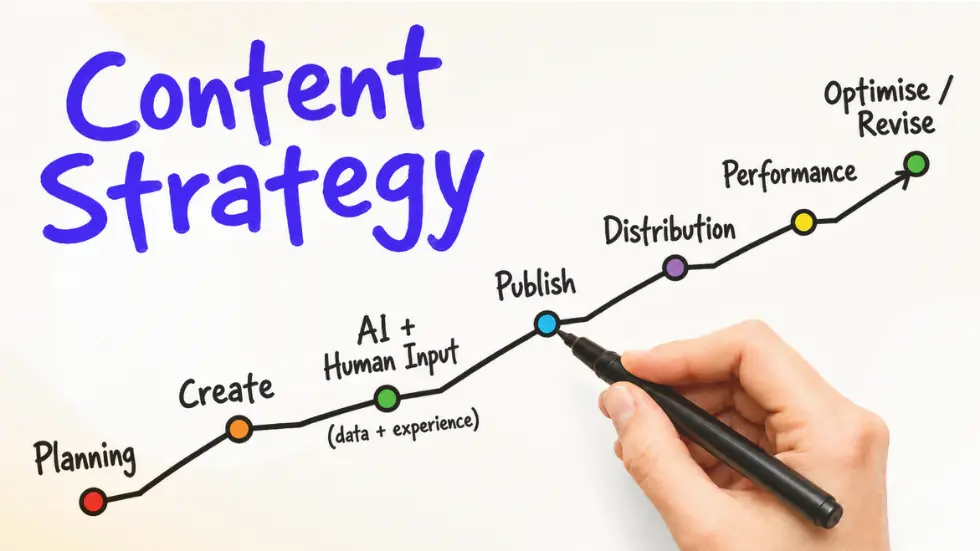
Content marketing is not just about publishing blog posts, videos, and social media updates. At its best, it becomes a system that attracts the right audience, earns trust, and turns attention into qualified leads over time.
Many businesses do not treat it that way. They publish when they have time, allow competitors to influence their topics, and follow trends without asking whether those trends match customer needs.
The results are usually predictable. A blog gets little traffic, social posts receive a few likes but no serious inquiries, and website visitors read the content but do not know what to do next.
That is not always a content problem. Often, it is a content marketing strategy problem.
A strong content marketing strategy gives your content direction. It helps you understand who you are creating for, what problems you are solving, where your content should appear, and how it should support lead generation.
This guide explains how to build that kind of strategy. You will learn what content marketing is, why strategy matters, how to understand your audience, which content formats to use, how to apply AI and research tools responsibly, and how to distribute your content through SEO, social media, paid ads, email, forums, and communities.
Most importantly, this guide focuses on creating content that is practical, human, data-driven, and connected to real business outcomes.
Let’s get into it.
What Is Content Marketing?
Content marketing is the process of creating and sharing useful content to attract, educate, and convert a clearly defined audience. Publishing alone is not the goal.
The real goal is to help potential customers understand their problem, trust your expertise, and take the next step with your business. That next step may be reading another guide, signing up for a newsletter, downloading a checklist, requesting an audit, booking a consultation, or making an inquiry.
Traditional advertising usually starts with the offer. Content marketing starts with the audience.
Instead of leading with “buy from us,” strong content begins with the questions your audience is already asking. What problem are they trying to solve, which decision are they preparing to make, and what information would help them move forward with confidence?
These questions matter because content marketing works best when it is useful before it is promotional.
A clinic, for example, should not only publish content saying it offers medical services. That is too general.
A stronger approach would be to answer the questions patients may ask before booking an appointment.
This could include symptoms that should not be ignored, when to see a specialist, how to prepare for a consultation, or which treatment options are available for a common condition.
This type of content is more useful because it meets people at the point of concern. Trust begins before the patient ever makes contact.
The same applies across industries. A law firm can explain legal decisions business owners face, real estate companies can guide buyers through property checks, schools can help parents understand curriculum choices, construction companies can explain what clients should know before starting a project, and ecommerce brands can help customers choose the right product and use it better.
The format may change, but the purpose remains the same. Useful content answers real questions and gives people a reason to trust your business.
Why Content Marketing Strategy Matters
Many businesses create content without a clear plan. They may have a blog, post on social media every week, send occasional emails, and run paid ads from time to time.
But when you ask why a specific piece of content was created, the answer is often unclear. That is where the problem begins.
A content marketing strategy connects content to business outcomes. It helps you decide what to create, who to create it for, how people will discover it, and what action they should take next.
Without strategy, content becomes random. You may create a good article for the wrong audience, publish a strong social media post that does not connect to your website or sales process, or increase traffic from people who are unlikely to become customers.
Strategy helps prevent that waste. It keeps content focused on leads, sales, trust, and long-term visibility instead of activity alone.
A good content marketing strategy also improves consistency. Not just consistency in posting, but consistency in message, audience focus, content quality, distribution, and measurement.
This matters because content marketing rarely works overnight. One article may not change your business, a single LinkedIn post may not bring qualified leads, and one video may not build authority on its own.
But a system of useful content, created around real audience demand and distributed properly, can build value over time. That is when content becomes a business asset.
The Real Problem With Generic Content
The internet does not need another generic article. Most topics have already been covered many times.
If your business publishes the same broad definitions, general advice, and surface-level examples, it becomes difficult to stand out. Even when the information is correct, the content may still be forgettable.
That is the problem with generic content. It sounds safe, but it does not make the reader feel understood.
A generic article says content marketing builds trust. A useful article shows how trust is built before a sales conversation begins.
Generic advice tells you to know your audience. A practical guide explains how to study customer questions, search behaviour, sales objections, reviews, comments, and community discussions to understand what people actually need.
Broad content says distribution matters. Useful content shows how one strong guide can become search content, social media posts, email material, paid ad support, sales enablement, and community responses.
There is a clear difference. Good content does not only explain a topic. It helps the reader make a better decision.
Start With the Audience, Not the Topic
One of the biggest mistakes businesses make is starting with content ideas. The question often sounds like this: “What should we post this week?”
It feels practical, but it usually leads to weak content. A better question is: “What does our audience need to understand before they are ready to trust us?”
That changes everything.
A law firm’s audience may not begin by searching for legal services. They may first be trying to understand whether they need a contract, what risks they face, or which steps to follow before registering a business.
Real estate buyers may not immediately ask for an agent. Their first concern may be how to verify land ownership, what to check before buying property, or how financing works.
Parents comparing schools are not always ready to enroll on the first visit. They may first want to understand the curriculum, fees, learning environment, transport options, and whether the school fits their child.
Your content should meet people at those decision points, not where you wish they were. Where they actually are.
Audience research helps you see this clearly. Start by reviewing the questions prospects ask before they buy, the doubts they express, the objections that slow down decisions, and the phrases they use when describing their problems.
Those details are often better content ideas than anything from a generic topic list.
Search data can also help. Review the queries people use before landing on your website, check which pages attract traffic but fail to convert, and study competitor content to see what they have missed, oversimplified, or explained poorly.
Customer reviews, support messages, social media comments, and community discussions can also reveal demand. The goal is not to collect information for the sake of it. It is to understand what your audience already cares about.
Once your content starts there, it becomes more relevant. Relevant content has a better chance of attracting the right people.
Study Search Intent Before Writing
Search intent is the reason behind a search query. It tells you what someone wants when they type a phrase into Google.
Ranking is not only about using keywords. Your content must match what the searcher expects to find.
Someone searching “content marketing examples” probably wants examples. A person searching “how to create a content marketing strategy” wants a process, while people looking for “content marketing services” may be comparing providers or trying to understand what the service includes.
Writing without understanding intent is risky. You may create a detailed guide when the reader wanted a checklist, a service page when the searcher wanted an educational article, or a broad definition when the reader wanted practical steps.
Before writing important content, study the search results for your target keyword. Look at whether the ranking pages are guides, service pages, list articles, templates, short answers, or detailed tutorials.
This simple exercise helps you avoid creating the wrong type of content. It also shows what is missing.
Do not copy the top-ranking pages. Study them, then look for a stronger angle.
Ask what they explained well, where their examples are too generic, which questions remain unanswered, and how your business can add experience, context, proof, or a clearer point of view.
That is how content becomes more than optimized. It becomes valuable.
Build Content Around Business Value
Not every keyword deserves your attention. Some topics may bring traffic without bringing the right audience.
That does not mean informational content is useless. Educational content matters because it builds trust and helps people understand their problem.
But every topic needs a reason for existing.
Take three related search terms: travel, travel packages, and family holiday packages in Kenya. They may look similar, but they do not serve the same purpose.
“Travel” is broad. The person searching may be looking for news, inspiration, jobs, destinations, travel tips, or general information.
“Travel packages” is more practical. The reader is likely comparing options and trying to understand what kind of trip they can book.
“Family holiday packages in Kenya” is closer to a buying decision. Someone using that phrase probably has a clearer destination interest, travel group, and reason for searching.
A strong content plan understands these differences. Broad educational content helps people explore ideas, practical content helps them compare options, and service-focused content helps them take the next step.
This is how content guides the reader forward.
After someone understands what kind of trip they want, show them the next useful step. A reader exploring destinations may need a guide to the best family-friendly places to visit, while someone comparing packages may need pricing details, itineraries, accommodation options, or a booking inquiry form.
The goal is not to attract everyone searching for travel. The goal is to attract the right people and help them move forward without confusion.
Choose the Right Types of Content
Content marketing includes more than blog posts. That does not mean every business needs every format.
The right format depends on your audience, message, platform, and business goal.
Some topics need depth. A detailed guide works well when the reader needs a full explanation, practical steps, and examples.
Other topics need speed. A short social media post may be enough to share one useful insight or start a conversation.
Proof requires a different format. A case study is stronger when the reader wants evidence that your solution works.
Action-focused topics may need a checklist, template, or downloadable guide because those formats help the reader apply what they have learned.
Complex explanations sometimes need video. A process that feels heavy in writing may become easier to understand when explained visually.
Longer relationships often need email. Someone may be interested today but not ready to buy until later.
The mistake is choosing formats because they are popular. Do not create videos just because everyone is creating videos, avoid long blogs when the topic only needs a short explanation, and do not post daily on social media if the content has no clear message.
Start with the audience and the goal. Then choose the format that best serves the idea.
A property company may use blogs to explain the buying process, videos to show project progress, and email to nurture interested buyers. Schools may use guides to answer parent questions, social media to show school life, and downloadable brochures to support inquiries.
Clinics may use educational articles to explain conditions, short videos to answer common questions, and appointment-focused landing pages for conversion.
Each format has a role. The strategy is what connects them.
Create a Human, Data-Driven Strategy
A content marketing strategy should not be based on guesswork. It should be built from evidence.
That evidence may come from customer conversations, search behaviour, website analytics, sales objections, reviews, social media comments, competitor gaps, and community discussions.
Data alone is not enough. Human understanding is still needed.
A research tool may show that people are searching for “content marketing lead generation.” But it will not fully explain what is behind that search.
Maybe the person is tired of publishing blogs with no inquiries. Perhaps they depend too much on paid ads, their website gets visitors but few qualified leads, or they do not know how to move someone from reading an article to booking a consultation.
That human layer matters.
Good content is created at the intersection of data and empathy. The data shows what people are searching for, while human insight explains why they care.
When both are present, your content becomes more useful. It stops sounding like theory and starts helping people solve real problems.
How to Create a Content Marketing Strategy
A practical content marketing strategy does not have to be complicated. Start with the business goal.
Do you want more qualified leads, better search visibility, or content that educates prospects before they contact you? Maybe the goal is to support your sales team or reduce dependence on paid ads.
The answer will shape the entire strategy.
After that, define the audience. Do not stop at broad descriptions like “business owners,” “parents,” “patients,” or “property buyers.”
Go deeper.
A parent comparing schools has different content needs from a parent ready to enroll. Patients researching symptoms need different information from people already looking for a clinic, and a business owner learning about lead generation is not in the same position as one comparing service providers.
The more specific the audience, the sharper the content.
Next, identify the problems your audience is trying to solve. This is where many content plans become weak because they move from audience to topics too quickly.
Do not just ask what people might read. Ask what they need to understand before they can take action.
Then group those problems into content pillars. A school might build pillars around admissions, curriculum, student life, parent guidance, fees, and learning outcomes.
A real estate company might focus on property buying, financing, location guides, legal checks, project updates, and investment education. Healthcare providers may organize content around symptoms, prevention, treatment options, appointment preparation, and patient education.
A financial platform could build around budgeting, savings, security, transactions, financial habits, and product education. Each pillar should support a topic your business wants to be trusted for.
After that, map content to the buyer journey.
Some people are just discovering the problem, so they need simple educational content. Others are comparing options and need guides, examples, comparisons, and proof.
Prospects close to taking action need service information, case studies, FAQs, forms, consultations, and clear next steps.
This helps you avoid creating only awareness content. Awareness matters, but it is not enough.
A business needs content that attracts, educates, nurtures, and converts.
Use AI and Research Tools the Right Way
AI tools can support content marketing. They should not replace strategy.
Use them to organize ideas, explore angles, group keywords, simplify explanations, draft outlines, and repurpose content into different formats. This can help your team move faster and reveal patterns you may have missed.
But speed is not the same as quality.
If AI creates content without clear audience insight, the result often sounds generic. The writing may be clean and the structure may look fine, but the article may still sound like everything else online.
That is not enough.
Use AI as an assistant, not the source of your strategy. Your business still needs to bring the real substance, including customer knowledge, industry experience, service expertise, proof, examples, market context, and a clear point of view.
AI can help with the writing process. It cannot understand your customers better than you do unless you give it the right context.
Start with real audience insight. Then use tools to sharpen, organize, and improve the work.
Create Content With Distribution in Mind
One of the biggest content marketing mistakes is creating first and thinking about distribution later. That is how good content gets ignored.
A business publishes an article, shares the link once, and waits. This is the “publish and pray” approach, and it rarely works.
Before creating content, ask how it will reach people. Will people find it through Google, could it work as a LinkedIn post, is there a short video angle, can the idea support an email sequence, would it make sense as paid ad material, could it answer a question in a community, and will the sales team be able to send it to prospects?
These questions change how you create.
If SEO is the main channel, study search intent, competing pages, keyword difficulty, internal structure, and related questions. When social media is part of the plan, the content needs strong ideas that can stand alone as posts.
Paid promotion needs a clear offer. A guide, checklist, webinar, or audit often works better than a basic blog post.
Community distribution requires a different mindset. The content must answer real questions without sounding promotional.
Distribution should shape the content from the beginning. That is how one article becomes more than one article.
SEO and Content Marketing
Search engine optimization and content marketing work closely together. SEO helps people find your content, while content gives search engines something useful to rank.
But SEO is not just about adding keywords. That is where many businesses go wrong.
They repeat the primary keyword too many times, force related terms into headings, and write for algorithms before people. This usually makes the content worse.
A better approach is to focus on search intent.
If the target keyword is “content marketing strategy,” the content should genuinely explain how to create one. It should answer the questions a reader is likely to have.
What is content marketing, why does strategy matter, which content types should you use, how do you understand your audience, where does content support lead generation, which distribution channels matter, and how should results be measured?
When those questions are answered well, secondary keywords fit naturally. That is better than repeating the same phrase in every heading.
Good SEO content should also help the reader move logically from one topic to the next. Someone learning about content strategy may also need to understand lead generation, SEO, social media, website conversion, or content marketing services.
Guide them where it makes sense. Do it because it helps the reader, not because you are trying to force links into the page.
Social Media, Paid Ads, and Communities
Content marketing does not end on your website. Your audience may discover you on Google, but they may also find you on LinkedIn, Facebook, Instagram, TikTok, YouTube, Reddit, Quora, or industry communities.
That is why distribution needs range.
Social media helps you turn long-form ideas into shorter, more visible insights. A detailed guide can become a LinkedIn post, a carousel, a short video, or an email topic.
This is not duplication. It is repurposing.
People consume content differently on different platforms. Some will read the full guide, while others may notice a short post first and visit your website later.
Paid ads can also support content marketing. Instead of only promoting your service directly, promote a useful guide, checklist, audit, webinar, or report.
This works especially well when your audience is interested but not ready to buy immediately.
Communities need a different approach. Reddit, Quora, and niche forums are not places to dump links.
People can tell when a brand is only there to promote itself. A better approach is to answer questions properly, share useful context, be specific, and point people to more resources only when it genuinely helps the discussion.
The best community marketing starts with listening. You will often find better content ideas in real discussions than in a brainstorming session.
Content Marketing for Lead Generation
Content marketing should not only attract attention. It should help turn attention into action.
That is where lead generation comes in.
A person may read your article and find it useful. Without a clear next step, the journey ends there.
That becomes a missed opportunity.
A good content marketing strategy creates conversion paths. A blog post can lead to a downloadable checklist, guides can lead to audits or consultations, case studies can support service inquiries, service comparisons can lead to quote requests, and webinars can start sales conversations.
The offer should match the reader’s stage.
Someone reading a beginner guide may not be ready to contact your team. They may still download a checklist or subscribe for more insights.
A person searching for services is much closer to making an inquiry. That reader needs clarity, proof, and a direct next step.
This is why content should be connected to lead generation. Not every piece of content needs to sell, but every important piece should help the reader move forward.
Content Marketing Dos and Don’ts
There are a few rules worth keeping in mind. Start with audience demand, study search intent before writing, build around business value, write for people first, plan distribution early, repurpose strong ideas, and measure what matters.
A keyword is only useful when you understand what the searcher expects. Traffic is good, but qualified traffic is better.
Search engines matter, but people decide whether your content is useful. Likes and impressions are useful signals, but leads, conversions, rankings, and sales influence matter more.
Now for what to avoid.
Do not create content just to fill a calendar. Avoid copying competitor articles and expecting to stand out.
Never rely on AI without strategy. Do not stuff keywords into every heading, turn every article into a sales pitch, or publish and disappear.
More content does not automatically mean better results. Sometimes the best move is not publishing another article, but improving the one that already has potential.
How to Measure Content Marketing Success
Content marketing should be measured based on the goal.
If the goal is SEO, look at impressions, clicks, rankings, indexed pages, backlinks, and organic traffic. For engagement, study time on page, scroll depth, comments, shares, saves, and returning visitors.
Lead generation requires a different view. Track form submissions, consultation requests, downloads, newsletter signups, audit requests, and lead quality.
Sales support should also be measured. Look at how often content is used in sales conversations, proposals, follow-ups, and lead nurturing.
Do not judge every piece of content the same way.
A case study may not bring huge traffic, but it can help close serious prospects. A beginner guide may attract many visitors but fewer immediate leads, while service pages may get less traffic but convert better.
A good report looks at the full picture.
Use search data to understand visibility, website analytics to study user behaviour, and your CRM or lead tracking system to reveal which content contributes to inquiries and sales.
Then improve.
Content marketing is not a one-time activity. It is a cycle of publishing, distributing, measuring, learning, and updating.
When to Consider Content Marketing Services
Some businesses can manage content internally. Others need support because strategy, research, writing, SEO, distribution, and reporting require time and skill.
You may need content marketing services if your content is inconsistent, your blogs are not ranking, your social media content is disconnected from your website or sales process, or your content attracts attention but does not generate leads.
This happens often.
A business may know its industry very well, but still struggle to turn that expertise into clear content. Good content marketing services should help with more than writing.
They should help you understand your audience, choose the right topics, create practical content, optimize for search, distribute across channels, and measure performance.
The goal should be clear. Content should support visibility, trust, authority, and lead generation.
Some articles attract new visitors, others educate prospects, some answer objections, and a few support sales conversations. The strongest pieces help convert readers into leads.
Strategy brings all of that together.
Final Thoughts
Content marketing is not about publishing more for the sake of publishing. It is about creating useful content that helps the right people find you, understand you, trust you, and take action.
A strong content marketing strategy starts with the audience. It studies demand before creating topics.
Research, customer conversations, search behaviour, analytics, and market insight help reveal what people actually care about. Distribution must also be planned before content goes live.
SEO matters. Social media matters. Paid ads can help. Email can nurture. Communities can reveal demand. Sales teams can use content to answer objections.
But none of that works well when the content is generic.
Generic content is easy to create. Useful content takes more work.
It needs research, structure, examples, clarity, distribution, and measurement.
The reward is worth it.
When done well, content marketing becomes more than a marketing activity. It becomes a long-term growth system that builds traffic, trust, and qualified leads over time.
If your content is not attracting the right audience, generating qualified leads, or supporting your sales process, a more strategic approach can help.
FutureX can help you turn scattered content efforts into a focused 90-day content marketing sprint built around audience research, SEO, content planning, distribution, and lead generation.
Start with a clear strategy. Create content with purpose. Build a system that brings the right people closer to your business.
