

Artificial intelligence (AI) is slowly changing how real estate brands in Kenya (and beyond) are discovered, compared and evaluated online.
Today, discovery is no longer limited to Google search, social media, property platforms, referrals or paid ads.
Most customers now use AI tools as part of the research process, especially when comparing companies, assessing credibility or reviewing what to check before making a property decision.
For real estate brands, this creates a new visibility question:
Can AI tools find, understand, cite, mention, recommend and confidently describe your company?
At FutureX Digital Solutions, we ran an AI discoverability study to understand how selected AI platforms respond to real estate-related prompts.
Please note that this study’s intentions were never to rank the best companies.
Instead, it focuses on understanding what sources the AI platforms cited, which brands they mentioned or recommended and what types of digital signals support visibility in AI-generated answers.
Before we dive deeper into the results, here’s a brief overview of what we tested.
What we tested
We ran 15 selected prompts across five AI tools:
- ChatGPT
- Gemini
- Microsoft Copilot
- Meta AI
- Google AI Overview
This produced 75 AI responses.
The prompts were grouped into three categories:
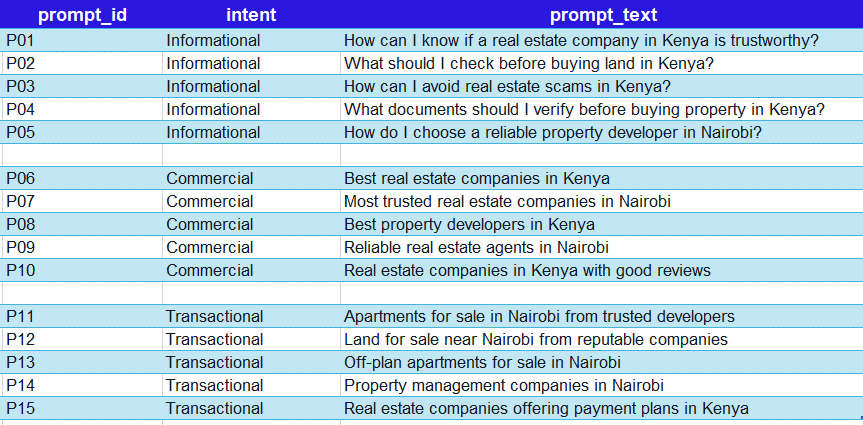
The informational prompts focused on buyer trust, due diligence, fraud prevention and how companies can be evaluated before a decision is made.
Next, the commercial prompts looked at comparison and recommendation scenarios while the transactional prompts focused on stronger action intent.
Google AI Overview was included because it reflects passive AI exposure inside normal Google search results.
Unlike chatbot tools, AI Overview only appears when Google chooses to generate one for a query.
Where Google AI Overview did not appear, Google AI Mode was checked as a fallback reference, but the main platform comparison remained focused on the five AI environments listed above.
We then documented all the responses (we did not ask any follow-up questions).
Here’s what we looked for in each response:
What we looked for
For each AI response, we reviewed three main visibility signals:
- Citations: the websites, domains or sources referenced by the AI platform.
- Brand mentions: the real estate brands, platforms, institutions or companies named in the response.
- Recommendations: brands positioned as suitable, trusted, leading, reliable or relevant options.
We also reviewed the type of content being cited.
For example, whether a cited source was a buyer education guide, legal guide, developer page, property portal, ranking/listicle, among others.
We also focused entirely on the sources that were actually cited in the main response. Consequently, sources that appeared as related or suggested links but were not used as references were removed from the final source analysis.
After cleaning the data, the study included:
- 75 AI responses analysed
- 245 source rows coded
- 360 total citations
- 312 brand recommendation rows
After carefully analysing the dataset, here’s what we found out:
The key finding: AI visibility changes by intent
The analysis showed that AI discoverability is not one thing.
The type of visibility changes depending on the intent of the prompt.
For informational intent, source visibility was key, compared to brand recommendation visibility for commercial intent and action-page visibility for transactional intent.
When we ran informational prompts, the AI tools mainly cited buyer education and legal due diligence content. Notably, there was no single brand recommendation in the informational prompt responses.
But when we shifted to commercial prompts, the AI platforms produced the highest number of brand recommendations.
And when we tested transactional prompts, they cited more company pages, project pages, property portals and payment-plan content.
This shows that your real estate brand can be visible in one part of the AI visibility journey but weak in another.
For instance, your company may be mentioned when a user asks for the “best real estate company” and be absent when they ask transactional prompts about apartments, land payment plans or property management solutions.
Another company may not appear as a recommended brand, but its educational content may be cited when AI answers questions about fraud, documents, title verification, or due diligence.
That distinction matters.
Let’s dive deeper into each search intent:
What the informational prompts showed
For informational prompts, AI platforms did not recommend any brand.
They cited sources that help explain trust, risk, verification and due diligence.
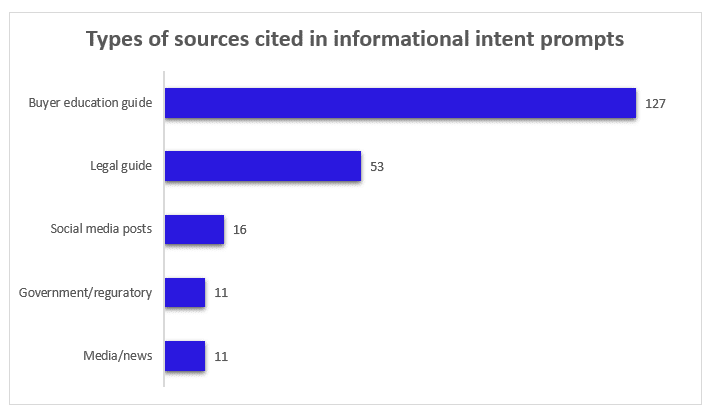
The results show that 55.5% of all citations in this category were buyer’s educational guides, followed by legal guides (23.1%) and social media posts (7.0%).
This was one of the strongest findings in the study.
For informational prompts, AI platforms appeared to rely more on content that helps reduce uncertainty than content that promotes a company.
They cited sources that explained key things like title deed checks, land searches, seller verification, EARB registration, surveyor checks, scam red flags and developer track record.
This suggests that your companies should not only publish listings, project updates and sales posts.
You need content that answers buyer trust questions clearly.
Although you may say that your company is trusted, AI tools are more likely to cite content that explains how trust can actually be verified.
So then the question you should ask yourself is – if I position my brand as trustworthy, does this reflect across external sources?
What do your customers say on social media? Or do you have a recent scandal in the news?
A user may not be able to scan through all the web sources manually, but an AI tool will do so in seconds.
Make sure your brand message is consistent across channels, whether earned, owned or paid.
Now let’s see what the commercial prompts revealed:
What the commercial prompts showed
Commercial prompts generated the highest number of brand recommendations.
These were prompts where the AI platforms were asked to compare, shortlist, or recommend real estate companies, developers, agents, or brands with good reviews.
The source pattern also changed.
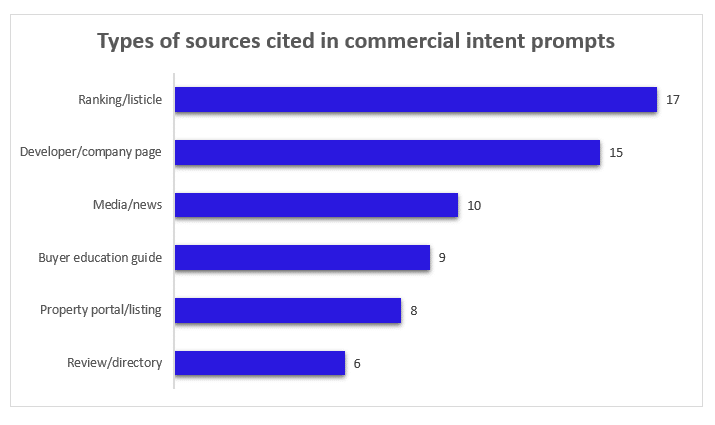
The platforms largely relied on rankings or listicles, company pages and the news to compare the companies before giving recommendations.
This suggests that commercial AI visibility is influenced by both the owned and earned digital signals.
Your owned signals may include your company website, service pages, project pages and helpful content published by your brand.
Equally important are the earned signals, which include third-party rankings, directories, media mentions, review platforms, property portals and industry references.
Therefore, for maximum AI visibility, having a website is not enough.
And don’t get me wrong. Publishing on-site is important (and you should address key questions your target customers might have).
However, you still need to monitor and influence how your brand is referenced across other external sources, including social media, communities and forums.
Just like humans, the AI platforms need enough public information to understand:
- What your company does
- Where it operates
- What category it belongs to
- Whether it focuses on land, apartments, property management, brokerage or development
- What makes it credible
- Whether other sources mention or validate it
If your company has limited public information, unclear service pages, weak third-party visibility or inconsistent business details, AI tools may struggle to mention or recommend it confidently.
And if such public information is there but negative, the AI tools will equally discourage users from choosing you when discussions about trust and credibility come up.
So you have to trade carefully.
Maybe a good number of your customers won’t afford a lawyer (or don’t know they need one) to do due diligence before buying your products.
But any AI tool can do a deep investigation of your brand across the web and report on it in seconds.
Thanks to the AI evolution, everyone gets a private investigator.
Lastly, ask yourself whether your brand comes up as a solution when your target customers are close to making a decision.
Here’s what the transactional prompts revealed:
What the transactional prompts showed
Transactional prompts were more action-oriented as they tested scenarios closer to a buying, booking or enquiry stage.
The cited sources shifted again.
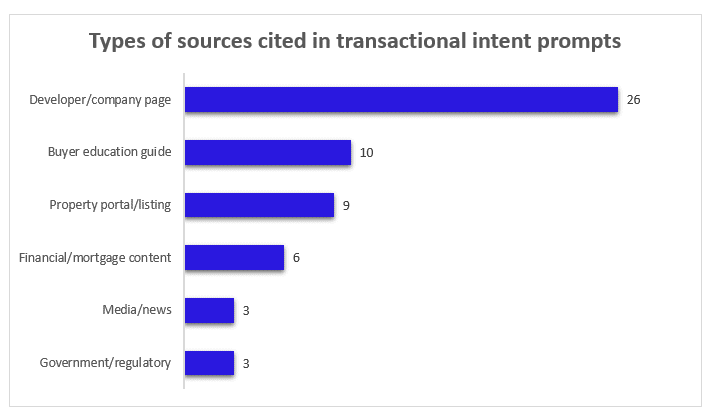
For transactional prompts, AI platforms cited more company-owned pages, developer pages, property portals, project pages, payment-plan pages and financing-related content.
This suggests that transactional AI visibility depends on pages that help answer immediate action questions.
Strong transactional pages should include location, price range, unit type or plot size, project status, payment plan, site visit process, FAQs and contact or booking path.
A generic page saying “apartments for sale in Nairobi” is weaker than a page that gives clear, structured, and extractable information.
This is especially important for companies selling land, apartments, off-plan projects or property management services.
And to be honest, this has not changed from traditional search engine optimisation best practices.
Before we conclude this study, let’s have a broader picture of what sources were cited across the three search intents:
What the cited sources showed overall
Across all 75 AI-generated responses, buyer education guides were the most cited source type.
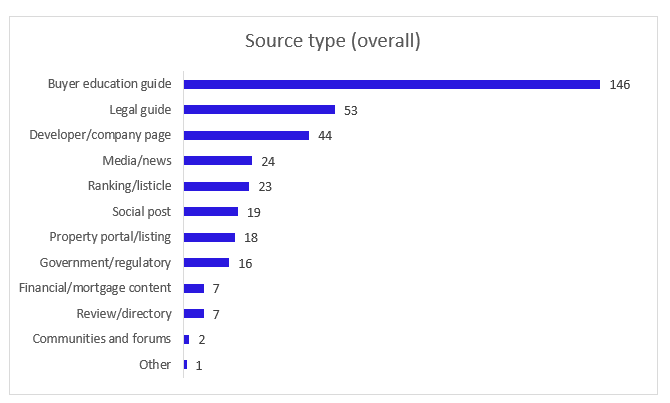
To be specific, 40.6% of the total citations came from buyer education guides.
This finding is important because it challenges a common assumption.
AI platforms were not only citing the biggest real estate brands or property portals.
They also cited legal firms, niche property blogs, buyer education pages, media articles, social posts, and company education content.
That means AI visibility is not reserved for the biggest brands.
A smaller or mid-sized real estate company can improve its AI visibility by becoming a useful, structured, credible source.
For starta, publish unique content that educate your audience and presents your projects or solutions clearly.
Then don’t practice what is often called ‘publish and pray’ – meaning you just publish content on your website or social media pages and hope your target audience will use it.
Of course you can do so if you’re guaranteed your competitors will not outdo you.
But if you want to stand out, publish with distribution in mind.
Repurpose your content into different formats, including text, images and videos and distribute it across different channels.
Platform-level findings
The citation data showed different behaviour across platforms.
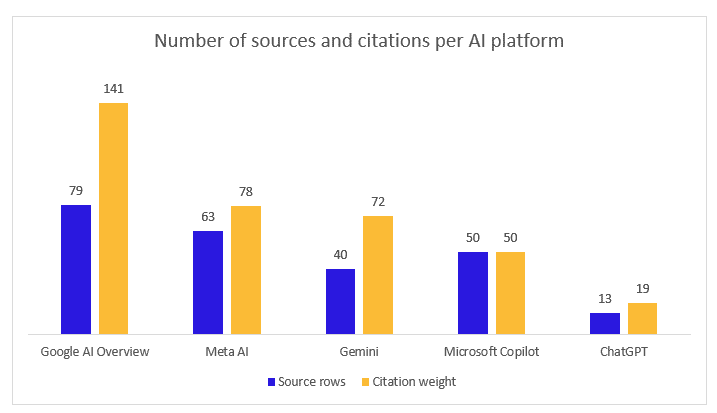
Google AI Overview produced the highest citation weight in the dataset, especially for informational prompts.
Meta AI showed the most balanced citation behaviour across informational, commercial and transactional prompts.
Gemini was strong for informational source visibility.
Microsoft Copilot became cleaner after removing uncited related sources and retaining only sources that were actually cited.
ChatGPT had the lowest explicit citation volume in this dataset but still produced brand recommendations.
This is why AI visibility should not be measured using citations alone.
Some AI platforms cite sources heavily while others mention and recommend brands without showing many explicit citations.
It was also evident that each tool relied on different sources, as there was no tool that cited the same sources as the other.
Therefore, before asking what AI tools your target customers are using, ask yourself if you have addressed all the search intents on your owned brands.
Then confirm if this is distributed consistently across the different platforms, including communities like Quora and Reddit and on social media.
And then now you can run an AI visibility study to identify what brands are coming up when you ask queries relating to your services and products and try to figure out why you’re not included.
This is not a guarantee that you’ll be cited, mentioned and recommended.
But it’s a better place to start than doing nothing.
Next, we explore what brands were recommended in our study:
What the brand recommendations showed
Brand recommendations were concentrated in commercial and transactional intent.
There was no single brand recommended when we asked informational prompts.
This does not mean that none of the sources came from real estate companies. Just that these brands were not directly mentioned or recommended – they were only cited.
For commercial intent, we saw 230 brand recommendations compared to 82 recommendations for transactional.
The most frequently recommended brands in the dataset included:
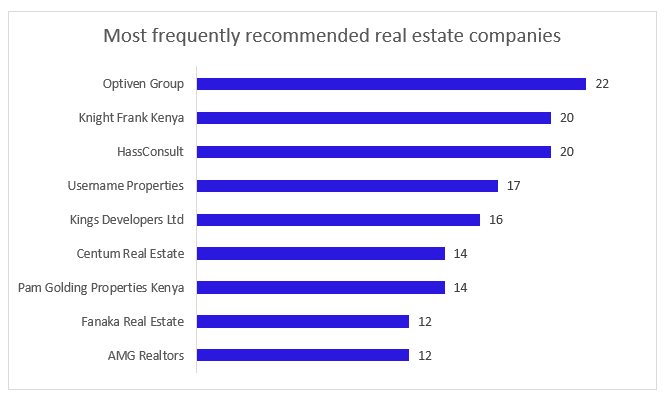
These results simply show which brands appeared more often in the AI responses we tested.
But they should not be interpreted as a final ranking of the best real estate companies in Kenya.
That distinction is important.
AI visibility is not the same as quality, credibility or endorsement in the real world.
It reflects the visibility signals available to the AI platform at the time of testing.
A brand may appear because it has a stronger public footprint or because it appears in third-party sources.
Another one may be recommended because it has recognisable projects, is listed on property platforms or because the AI tool has enough public information to describe it confidently.
Why AI discovery matters in real estate
Real estate is a high-trust industry.
Buyers are not just looking for available properties.
They are looking for signs that a company is legitimate, transparent, reliable and capable of helping them make a safe decision.
This is especially important in Kenya, where customers may be cautious about fraud, unclear ownership, delayed title processing, incomplete projects, misleading property information or unverified agents.
That is why AI visibility matters.
When an AI platform mentions or recommends a real estate brand, the question is not only whether the brand appeared.
The deeper question is: What public signals made the brand visible in the first place?
Those signals may include:
- Search visibility
- Google reviews
- Property portals
- Third-party mentions
- Directory listings
- Media coverage
- Social proof
- Educational content
- Legal or verification content
- Structured project pages
- Clear location and service information
AI platforms do not only respond to what a company says about itself.
They may also rely on visible public signals across websites, citations, reviews, directories, media, social platforms and other sources.
Your real estate company may be active on social media. But if your website is thin, project pages are unclear, business information is inconsistent and your brand has few credible mentions elsewhere, AI platforms may have limited information to work with.
And in most cases, no information means no citation or recommendations.
AI visibility is also about trust
The study reinforces an important point: AI visibility and buyer trust are closely connected.
When tested with prompts about trusted real estate companies, reliable developers, good reviews, scams, documents, and due diligence, the AI platforms repeatedly surfaced trust-related signals.
That is why real estate brands need a digital presence that does more than attract attention.
It should also reduce doubt.
A strong real estate digital footprint should help both buyers and AI platforms understand who the company is, what it offers, where it operates, what property category it serves, what proof supports its credibility, how buyers can verify its claims or even what steps buyers should take next.
Trust signals can come from several places.
Your own website can explain what you offer, where your projects are located, what price range you serve and how buyers can take the next step.
Property platforms can strengthen visibility around listings and project discovery.
Directories and industry lists can support commercial comparison prompts.
Legal, regulatory, and due diligence content can help buyers feel safer.
Reviews, media mentions, and social proof can reduce uncertainty.
The more complete this digital footprint is, the easier it becomes for both buyers and AI platforms to evaluate your brand.
What this means for real estate companies in Kenya
Real estate companies should start thinking beyond social media activity alone.
Posting consistently is useful, but it is not enough if buyers, search engines and AI tools cannot clearly understand what the company offers, where it operates, who it serves and why it can be trusted.
A stronger AI-ready digital presence should cover three layers.
1. Become AI-citable for informational prompts
This means publishing content that AI platforms can cite when responding to trust, safety and verification prompts.
Recommended content includes:
- How to know if a real estate company in Kenya is legit
- How to avoid real estate scams in Kenya
- Documents to verify before buying property in Kenya
- How to check a title deed in Kenya
- How to verify a developer before buying off-plan
- EARB, BRS, Ardhisasa and NCA checks explained for buyers
Of course, these are mere examples. Talk to us and we’ll help you create a digital growth strategy for your brand.
2. Become AI-recognizable for commercial prompts
This means building enough brand signals for AI platforms to understand and categorize the company.
Recommended actions include:
- Improve company profile pages
- Publish clear service and project pages
- Build reputation-focused content
- Get listed in credible directories
- Improve review visibility
- Earn media mentions
- Strengthen property portal presence
- Create comparison-style content around buyer decision criteria
3. Become AI-recommendable for transactional prompts
This means creating specific, action-ready pages that answer property search needs clearly.
Recommended pages include:
- Apartments for sale in Nairobi from trusted developers
- Land for sale near Nairobi with payment plans
- Off-plan apartments in Nairobi
- Property management services in Nairobi
- Payment-plan property options in Kenya
- Location-specific project pages
- Site visit booking pages
This is not an exhaustive list.
The practical takeaway
The future of real estate discovery will not depend on one channel.
Buyers may discover a brand through Google, social media, AI tools, referrals, property platforms, directories or third-party mentions.
For maximum benefits, ensure your digital presence is clear, consistent, searchable, useful, and trustworthy across these touchpoints.
This study does not claim to reveal exactly how AI tools rank or select real estate companies.
But it does show an important direction:
Real estate companies in Kenya need to build digital trust signals that make them easier to find, easier to verify and easier to recommend.
If your brand is not clear online, AI tools may struggle to understand it.
And if your content does not answer trust and verification questions, AI tools may cite other sources instead.
If your project pages are thin, AI tools may struggle to connect your brand to transactional prompts.
And if your digital presence only generates enquiries without building trust, you may continue attracting leads that do not convert.
At FutureX, we help real estate companies improve the digital systems that support visibility, trust, lead quality, and conversion.
From website structure and SEO to social media, content, landing pages, tracking, and lead qualification, the goal is not just to get more enquiries but to help serious prospects find, understand, trust, and contact your brand.
Request a detailed digital audit and let’s boost your digital visibility, helping your customers find you across different channels.
