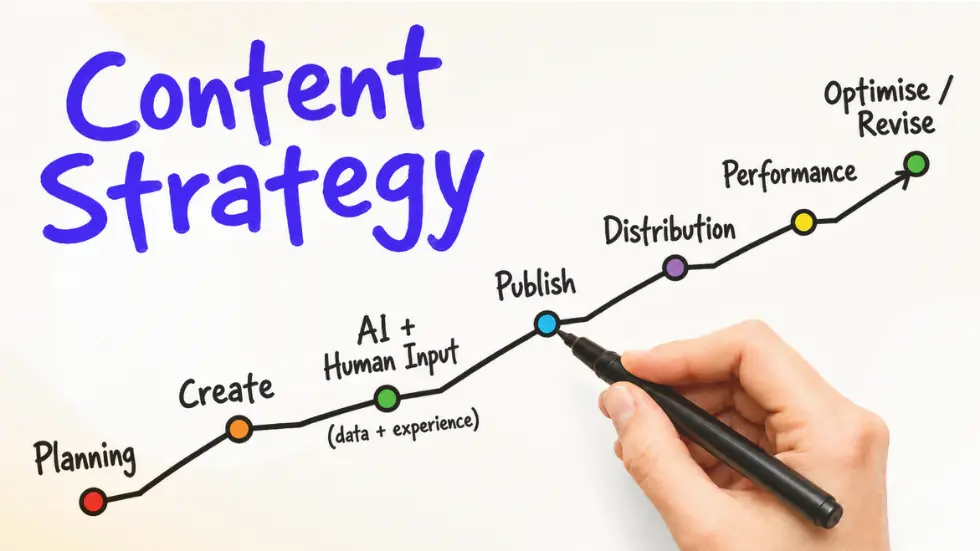
by FutureX | Jun 12, 2026 | Content Marketing
Content marketing is not just about publishing blog posts, videos, and social media updates. At its best, it becomes a system that attracts the right audience, earns trust, and turns attention into qualified leads over time.
Many businesses do not treat it that way. They publish when they have time, allow competitors to influence their topics, and follow trends without asking whether those trends match customer needs.
The results are usually predictable. A blog gets little traffic, social posts receive a few likes but no serious inquiries, and website visitors read the content but do not know what to do next.
That is not always a content problem. Often, it is a content marketing strategy problem.
A strong content marketing strategy gives your content direction. It helps you understand who you are creating for, what problems you are solving, where your content should appear, and how it should support lead generation.
This guide explains how to build that kind of strategy. You will learn what content marketing is, why strategy matters, how to understand your audience, which content formats to use, how to apply AI and research tools responsibly, and how to distribute your content through SEO, social media, paid ads, email, forums, and communities.
Most importantly, this guide focuses on creating content that is practical, human, data-driven, and connected to real business outcomes.
Let’s get into it.
What Is Content Marketing?
Content marketing is the process of creating and sharing useful content to attract, educate, and convert a clearly defined audience. Publishing alone is not the goal.
The real goal is to help potential customers understand their problem, trust your expertise, and take the next step with your business. That next step may be reading another guide, signing up for a newsletter, downloading a checklist, requesting an audit, booking a consultation, or making an inquiry.
Traditional advertising usually starts with the offer. Content marketing starts with the audience.
Instead of leading with “buy from us,” strong content begins with the questions your audience is already asking. What problem are they trying to solve, which decision are they preparing to make, and what information would help them move forward with confidence?
These questions matter because content marketing works best when it is useful before it is promotional.
A clinic, for example, should not only publish content saying it offers medical services. That is too general.
A stronger approach would be to answer the questions patients may ask before booking an appointment.
This could include symptoms that should not be ignored, when to see a specialist, how to prepare for a consultation, or which treatment options are available for a common condition.
This type of content is more useful because it meets people at the point of concern. Trust begins before the patient ever makes contact.
The same applies across industries. A law firm can explain legal decisions business owners face, real estate companies can guide buyers through property checks, schools can help parents understand curriculum choices, construction companies can explain what clients should know before starting a project, and ecommerce brands can help customers choose the right product and use it better.
The format may change, but the purpose remains the same. Useful content answers real questions and gives people a reason to trust your business.
Why Content Marketing Strategy Matters
Many businesses create content without a clear plan. They may have a blog, post on social media every week, send occasional emails, and run paid ads from time to time.
But when you ask why a specific piece of content was created, the answer is often unclear. That is where the problem begins.
A content marketing strategy connects content to business outcomes. It helps you decide what to create, who to create it for, how people will discover it, and what action they should take next.
Without strategy, content becomes random. You may create a good article for the wrong audience, publish a strong social media post that does not connect to your website or sales process, or increase traffic from people who are unlikely to become customers.
Strategy helps prevent that waste. It keeps content focused on leads, sales, trust, and long-term visibility instead of activity alone.
A good content marketing strategy also improves consistency. Not just consistency in posting, but consistency in message, audience focus, content quality, distribution, and measurement.
This matters because content marketing rarely works overnight. One article may not change your business, a single LinkedIn post may not bring qualified leads, and one video may not build authority on its own.
But a system of useful content, created around real audience demand and distributed properly, can build value over time. That is when content becomes a business asset.
The Real Problem With Generic Content
The internet does not need another generic article. Most topics have already been covered many times.
If your business publishes the same broad definitions, general advice, and surface-level examples, it becomes difficult to stand out. Even when the information is correct, the content may still be forgettable.
That is the problem with generic content. It sounds safe, but it does not make the reader feel understood.
A generic article says content marketing builds trust. A useful article shows how trust is built before a sales conversation begins.
Generic advice tells you to know your audience. A practical guide explains how to study customer questions, search behaviour, sales objections, reviews, comments, and community discussions to understand what people actually need.
Broad content says distribution matters. Useful content shows how one strong guide can become search content, social media posts, email material, paid ad support, sales enablement, and community responses.
There is a clear difference. Good content does not only explain a topic. It helps the reader make a better decision.
Start With the Audience, Not the Topic
One of the biggest mistakes businesses make is starting with content ideas. The question often sounds like this: “What should we post this week?”
It feels practical, but it usually leads to weak content. A better question is: “What does our audience need to understand before they are ready to trust us?”
That changes everything.
A law firm’s audience may not begin by searching for legal services. They may first be trying to understand whether they need a contract, what risks they face, or which steps to follow before registering a business.
Real estate buyers may not immediately ask for an agent. Their first concern may be how to verify land ownership, what to check before buying property, or how financing works.
Parents comparing schools are not always ready to enroll on the first visit. They may first want to understand the curriculum, fees, learning environment, transport options, and whether the school fits their child.
Your content should meet people at those decision points, not where you wish they were. Where they actually are.
Audience research helps you see this clearly. Start by reviewing the questions prospects ask before they buy, the doubts they express, the objections that slow down decisions, and the phrases they use when describing their problems.
Those details are often better content ideas than anything from a generic topic list.
Search data can also help. Review the queries people use before landing on your website, check which pages attract traffic but fail to convert, and study competitor content to see what they have missed, oversimplified, or explained poorly.
Customer reviews, support messages, social media comments, and community discussions can also reveal demand. The goal is not to collect information for the sake of it. It is to understand what your audience already cares about.
Once your content starts there, it becomes more relevant. Relevant content has a better chance of attracting the right people.
Study Search Intent Before Writing
Search intent is the reason behind a search query. It tells you what someone wants when they type a phrase into Google.
Ranking is not only about using keywords. Your content must match what the searcher expects to find.
Someone searching “content marketing examples” probably wants examples. A person searching “how to create a content marketing strategy” wants a process, while people looking for “content marketing services” may be comparing providers or trying to understand what the service includes.
Writing without understanding intent is risky. You may create a detailed guide when the reader wanted a checklist, a service page when the searcher wanted an educational article, or a broad definition when the reader wanted practical steps.
Before writing important content, study the search results for your target keyword. Look at whether the ranking pages are guides, service pages, list articles, templates, short answers, or detailed tutorials.
This simple exercise helps you avoid creating the wrong type of content. It also shows what is missing.
Do not copy the top-ranking pages. Study them, then look for a stronger angle.
Ask what they explained well, where their examples are too generic, which questions remain unanswered, and how your business can add experience, context, proof, or a clearer point of view.
That is how content becomes more than optimized. It becomes valuable.
Build Content Around Business Value
Not every keyword deserves your attention. Some topics may bring traffic without bringing the right audience.
That does not mean informational content is useless. Educational content matters because it builds trust and helps people understand their problem.
But every topic needs a reason for existing.
Take three related search terms: travel, travel packages, and family holiday packages in Kenya. They may look similar, but they do not serve the same purpose.
“Travel” is broad. The person searching may be looking for news, inspiration, jobs, destinations, travel tips, or general information.
“Travel packages” is more practical. The reader is likely comparing options and trying to understand what kind of trip they can book.
“Family holiday packages in Kenya” is closer to a buying decision. Someone using that phrase probably has a clearer destination interest, travel group, and reason for searching.
A strong content plan understands these differences. Broad educational content helps people explore ideas, practical content helps them compare options, and service-focused content helps them take the next step.
This is how content guides the reader forward.
After someone understands what kind of trip they want, show them the next useful step. A reader exploring destinations may need a guide to the best family-friendly places to visit, while someone comparing packages may need pricing details, itineraries, accommodation options, or a booking inquiry form.
The goal is not to attract everyone searching for travel. The goal is to attract the right people and help them move forward without confusion.
Choose the Right Types of Content
Content marketing includes more than blog posts. That does not mean every business needs every format.
The right format depends on your audience, message, platform, and business goal.
Some topics need depth. A detailed guide works well when the reader needs a full explanation, practical steps, and examples.
Other topics need speed. A short social media post may be enough to share one useful insight or start a conversation.
Proof requires a different format. A case study is stronger when the reader wants evidence that your solution works.
Action-focused topics may need a checklist, template, or downloadable guide because those formats help the reader apply what they have learned.
Complex explanations sometimes need video. A process that feels heavy in writing may become easier to understand when explained visually.
Longer relationships often need email. Someone may be interested today but not ready to buy until later.
The mistake is choosing formats because they are popular. Do not create videos just because everyone is creating videos, avoid long blogs when the topic only needs a short explanation, and do not post daily on social media if the content has no clear message.
Start with the audience and the goal. Then choose the format that best serves the idea.
A property company may use blogs to explain the buying process, videos to show project progress, and email to nurture interested buyers. Schools may use guides to answer parent questions, social media to show school life, and downloadable brochures to support inquiries.
Clinics may use educational articles to explain conditions, short videos to answer common questions, and appointment-focused landing pages for conversion.
Each format has a role. The strategy is what connects them.
Create a Human, Data-Driven Strategy
A content marketing strategy should not be based on guesswork. It should be built from evidence.
That evidence may come from customer conversations, search behaviour, website analytics, sales objections, reviews, social media comments, competitor gaps, and community discussions.
Data alone is not enough. Human understanding is still needed.
A research tool may show that people are searching for “content marketing lead generation.” But it will not fully explain what is behind that search.
Maybe the person is tired of publishing blogs with no inquiries. Perhaps they depend too much on paid ads, their website gets visitors but few qualified leads, or they do not know how to move someone from reading an article to booking a consultation.
That human layer matters.
Good content is created at the intersection of data and empathy. The data shows what people are searching for, while human insight explains why they care.
When both are present, your content becomes more useful. It stops sounding like theory and starts helping people solve real problems.
How to Create a Content Marketing Strategy
A practical content marketing strategy does not have to be complicated. Start with the business goal.
Do you want more qualified leads, better search visibility, or content that educates prospects before they contact you? Maybe the goal is to support your sales team or reduce dependence on paid ads.
The answer will shape the entire strategy.
After that, define the audience. Do not stop at broad descriptions like “business owners,” “parents,” “patients,” or “property buyers.”
Go deeper.
A parent comparing schools has different content needs from a parent ready to enroll. Patients researching symptoms need different information from people already looking for a clinic, and a business owner learning about lead generation is not in the same position as one comparing service providers.
The more specific the audience, the sharper the content.
Next, identify the problems your audience is trying to solve. This is where many content plans become weak because they move from audience to topics too quickly.
Do not just ask what people might read. Ask what they need to understand before they can take action.
Then group those problems into content pillars. A school might build pillars around admissions, curriculum, student life, parent guidance, fees, and learning outcomes.
A real estate company might focus on property buying, financing, location guides, legal checks, project updates, and investment education. Healthcare providers may organize content around symptoms, prevention, treatment options, appointment preparation, and patient education.
A financial platform could build around budgeting, savings, security, transactions, financial habits, and product education. Each pillar should support a topic your business wants to be trusted for.
After that, map content to the buyer journey.
Some people are just discovering the problem, so they need simple educational content. Others are comparing options and need guides, examples, comparisons, and proof.
Prospects close to taking action need service information, case studies, FAQs, forms, consultations, and clear next steps.
This helps you avoid creating only awareness content. Awareness matters, but it is not enough.
A business needs content that attracts, educates, nurtures, and converts.
Use AI and Research Tools the Right Way
AI tools can support content marketing. They should not replace strategy.
Use them to organize ideas, explore angles, group keywords, simplify explanations, draft outlines, and repurpose content into different formats. This can help your team move faster and reveal patterns you may have missed.
But speed is not the same as quality.
If AI creates content without clear audience insight, the result often sounds generic. The writing may be clean and the structure may look fine, but the article may still sound like everything else online.
That is not enough.
Use AI as an assistant, not the source of your strategy. Your business still needs to bring the real substance, including customer knowledge, industry experience, service expertise, proof, examples, market context, and a clear point of view.
AI can help with the writing process. It cannot understand your customers better than you do unless you give it the right context.
Start with real audience insight. Then use tools to sharpen, organize, and improve the work.
Create Content With Distribution in Mind
One of the biggest content marketing mistakes is creating first and thinking about distribution later. That is how good content gets ignored.
A business publishes an article, shares the link once, and waits. This is the “publish and pray” approach, and it rarely works.
Before creating content, ask how it will reach people. Will people find it through Google, could it work as a LinkedIn post, is there a short video angle, can the idea support an email sequence, would it make sense as paid ad material, could it answer a question in a community, and will the sales team be able to send it to prospects?
These questions change how you create.
If SEO is the main channel, study search intent, competing pages, keyword difficulty, internal structure, and related questions. When social media is part of the plan, the content needs strong ideas that can stand alone as posts.
Paid promotion needs a clear offer. A guide, checklist, webinar, or audit often works better than a basic blog post.
Community distribution requires a different mindset. The content must answer real questions without sounding promotional.
Distribution should shape the content from the beginning. That is how one article becomes more than one article.
SEO and Content Marketing
Search engine optimization and content marketing work closely together. SEO helps people find your content, while content gives search engines something useful to rank.
But SEO is not just about adding keywords. That is where many businesses go wrong.
They repeat the primary keyword too many times, force related terms into headings, and write for algorithms before people. This usually makes the content worse.
A better approach is to focus on search intent.
If the target keyword is “content marketing strategy,” the content should genuinely explain how to create one. It should answer the questions a reader is likely to have.
What is content marketing, why does strategy matter, which content types should you use, how do you understand your audience, where does content support lead generation, which distribution channels matter, and how should results be measured?
When those questions are answered well, secondary keywords fit naturally. That is better than repeating the same phrase in every heading.
Good SEO content should also help the reader move logically from one topic to the next. Someone learning about content strategy may also need to understand lead generation, SEO, social media, website conversion, or content marketing services.
Guide them where it makes sense. Do it because it helps the reader, not because you are trying to force links into the page.
Social Media, Paid Ads, and Communities
Content marketing does not end on your website. Your audience may discover you on Google, but they may also find you on LinkedIn, Facebook, Instagram, TikTok, YouTube, Reddit, Quora, or industry communities.
That is why distribution needs range.
Social media helps you turn long-form ideas into shorter, more visible insights. A detailed guide can become a LinkedIn post, a carousel, a short video, or an email topic.
This is not duplication. It is repurposing.
People consume content differently on different platforms. Some will read the full guide, while others may notice a short post first and visit your website later.
Paid ads can also support content marketing. Instead of only promoting your service directly, promote a useful guide, checklist, audit, webinar, or report.
This works especially well when your audience is interested but not ready to buy immediately.
Communities need a different approach. Reddit, Quora, and niche forums are not places to dump links.
People can tell when a brand is only there to promote itself. A better approach is to answer questions properly, share useful context, be specific, and point people to more resources only when it genuinely helps the discussion.
The best community marketing starts with listening. You will often find better content ideas in real discussions than in a brainstorming session.
Content Marketing for Lead Generation
Content marketing should not only attract attention. It should help turn attention into action.
That is where lead generation comes in.
A person may read your article and find it useful. Without a clear next step, the journey ends there.
That becomes a missed opportunity.
A good content marketing strategy creates conversion paths. A blog post can lead to a downloadable checklist, guides can lead to audits or consultations, case studies can support service inquiries, service comparisons can lead to quote requests, and webinars can start sales conversations.
The offer should match the reader’s stage.
Someone reading a beginner guide may not be ready to contact your team. They may still download a checklist or subscribe for more insights.
A person searching for services is much closer to making an inquiry. That reader needs clarity, proof, and a direct next step.
This is why content should be connected to lead generation. Not every piece of content needs to sell, but every important piece should help the reader move forward.
Content Marketing Dos and Don’ts
There are a few rules worth keeping in mind. Start with audience demand, study search intent before writing, build around business value, write for people first, plan distribution early, repurpose strong ideas, and measure what matters.
A keyword is only useful when you understand what the searcher expects. Traffic is good, but qualified traffic is better.
Search engines matter, but people decide whether your content is useful. Likes and impressions are useful signals, but leads, conversions, rankings, and sales influence matter more.
Now for what to avoid.
Do not create content just to fill a calendar. Avoid copying competitor articles and expecting to stand out.
Never rely on AI without strategy. Do not stuff keywords into every heading, turn every article into a sales pitch, or publish and disappear.
More content does not automatically mean better results. Sometimes the best move is not publishing another article, but improving the one that already has potential.
How to Measure Content Marketing Success
Content marketing should be measured based on the goal.
If the goal is SEO, look at impressions, clicks, rankings, indexed pages, backlinks, and organic traffic. For engagement, study time on page, scroll depth, comments, shares, saves, and returning visitors.
Lead generation requires a different view. Track form submissions, consultation requests, downloads, newsletter signups, audit requests, and lead quality.
Sales support should also be measured. Look at how often content is used in sales conversations, proposals, follow-ups, and lead nurturing.
Do not judge every piece of content the same way.
A case study may not bring huge traffic, but it can help close serious prospects. A beginner guide may attract many visitors but fewer immediate leads, while service pages may get less traffic but convert better.
A good report looks at the full picture.
Use search data to understand visibility, website analytics to study user behaviour, and your CRM or lead tracking system to reveal which content contributes to inquiries and sales.
Then improve.
Content marketing is not a one-time activity. It is a cycle of publishing, distributing, measuring, learning, and updating.
When to Consider Content Marketing Services
Some businesses can manage content internally. Others need support because strategy, research, writing, SEO, distribution, and reporting require time and skill.
You may need content marketing services if your content is inconsistent, your blogs are not ranking, your social media content is disconnected from your website or sales process, or your content attracts attention but does not generate leads.
This happens often.
A business may know its industry very well, but still struggle to turn that expertise into clear content. Good content marketing services should help with more than writing.
They should help you understand your audience, choose the right topics, create practical content, optimize for search, distribute across channels, and measure performance.
The goal should be clear. Content should support visibility, trust, authority, and lead generation.
Some articles attract new visitors, others educate prospects, some answer objections, and a few support sales conversations. The strongest pieces help convert readers into leads.
Strategy brings all of that together.
Final Thoughts
Content marketing is not about publishing more for the sake of publishing. It is about creating useful content that helps the right people find you, understand you, trust you, and take action.
A strong content marketing strategy starts with the audience. It studies demand before creating topics.
Research, customer conversations, search behaviour, analytics, and market insight help reveal what people actually care about. Distribution must also be planned before content goes live.
SEO matters. Social media matters. Paid ads can help. Email can nurture. Communities can reveal demand. Sales teams can use content to answer objections.
But none of that works well when the content is generic.
Generic content is easy to create. Useful content takes more work.
It needs research, structure, examples, clarity, distribution, and measurement.
The reward is worth it.
When done well, content marketing becomes more than a marketing activity. It becomes a long-term growth system that builds traffic, trust, and qualified leads over time.
If your content is not attracting the right audience, generating qualified leads, or supporting your sales process, a more strategic approach can help.
FutureX can help you turn scattered content efforts into a focused 90-day content marketing sprint built around audience research, SEO, content planning, distribution, and lead generation.
Start with a clear strategy. Create content with purpose. Build a system that brings the right people closer to your business.
by FutureX | Jun 5, 2026 | SEO
Search engine optimization has always been one of the strongest foundations of digital marketing. It helps businesses become visible when people are actively searching for answers, services, products, comparisons, and solutions.
But SEO only becomes powerful when it is guided by strategy.
A few years ago, many businesses treated SEO as a checklist of keywords, meta tags, backlinks, and blog posts. Today, that approach is no longer enough. Search engines are more advanced, competition is higher, and AI-powered search experiences are changing how people discover, compare, and evaluate businesses online.
This does not mean SEO is dead. It means businesses need a clearer SEO strategy that connects visibility to trust, qualified traffic, and measurable growth.
The real power of SEO strategy is that it turns search visibility into a long-term business asset. Instead of chasing random rankings, a strong SEO strategy helps a business understand what its audience is searching for, create useful content around those needs, structure the website clearly, and guide visitors toward meaningful actions.
For businesses in Kenya and those serving international markets, SEO remains a valuable digital growth channel. People still use search engines to find service providers, compare options, check credibility, and make buying decisions. The businesses that win are usually not the ones publishing the most content, but the ones building authority around the right topics.
What Is SEO Strategy?
An SEO strategy is a structured plan for improving how a business appears in organic search results. It defines which audiences to target, which search queries matter, what content should be created, how the website should be structured, and how organic visibility will support business goals.
SEO stands for search engine optimization. In simple terms, it is the process of helping search engines understand your website so that the right pages can appear when people search for relevant topics, services, or solutions.
A strong SEO strategy brings together technical SEO, content strategy, on-page optimization, local SEO, authority building, user experience, analytics, and conversion thinking. These parts should not work separately. They should support one clear goal: helping the right people discover your business and take the next step.
In digital marketing, SEO strategy plays a bigger role than simply increasing traffic. It supports brand visibility, demand generation, content planning, lead generation, and long-term customer acquisition. When SEO is connected to the wider marketing plan, it helps a business attract the right audience before they are ready to buy, educate them during the research stage, and guide them toward the next step when they are ready to act.
This is why SEO strategy in digital marketing should start with business objectives, not just keyword lists. A real estate company, clinic, law firm, ecommerce brand, B2B service provider, or construction company will not need the same SEO plan. Each business needs a strategy based on its audience, competition, market, services, and growth priorities.
Why SEO Still Matters in the AI Era
SEO is still worth it because search remains one of the strongest ways people express intent. When someone searches for “SEO services Kenya,” “best real estate company in Nairobi,” “digital marketing strategy,” or “how to improve website leads,” they are not passively scrolling. They are actively looking for information, comparison, or a solution.
AI has changed how search works, but it has not removed the need for search visibility. In fact, AI-powered results often depend on structured, useful, credible content from across the web. If your business has weak content, poor site structure, unclear service pages, or limited authority, it becomes harder to appear in both traditional search results and AI-assisted discovery.
This is where SEO, generative engine optimization, and answer engine optimization begin to overlap. Traditional SEO helps your website appear in search results. Answer engine optimization focuses on making your content clear enough to answer specific questions. Generative engine optimization considers how AI systems may understand, summarize, or reference your content.
A practical SEO strategy for the AI era should not chase every new label. It should focus on the fundamentals that matter across all discovery systems: clear expertise, useful answers, structured information, trusted brand signals, and content that reflects real business experience.
SEO vs GEO, AEO, and AI Search Optimization
There is growing interest in terms such as GEO, AEO, LLMO, and AI SEO strategy. These ideas matter, but they should not distract businesses from the core purpose of organic visibility.
Generative engine optimization, often called GEO, focuses on improving how content may appear or be referenced in AI-generated search experiences. Answer engine optimization, or AEO, focuses on making content clear, direct, and useful for question-based searches. AI search optimization looks at how businesses can stay visible as platforms like Google, ChatGPT, Perplexity, Gemini, and other AI-driven systems influence discovery.
SEO remains the foundation. Without a technically sound website, strong content, credible pages, and clear authority signals, AI-focused visibility becomes harder. AI systems still need information to interpret, and that information often comes from well-structured websites, trusted sources, brand mentions, reviews, and useful content.
Instead of thinking about SEO vs GEO or AEO as separate battles, businesses should build content that works across discovery channels. A page should explain topics clearly, answer real questions, show expertise, connect related ideas, and guide users toward the next logical step.
What a Strong SEO Strategy Should Include
A strong SEO strategy begins with search intent. Before creating content, a business should understand what potential customers are actually trying to achieve when they search. Some users want definitions. Others want comparisons, pricing guidance, service providers, examples, or step-by-step explanations.
Technical SEO is another foundation. Search engines need to crawl, index, and understand your pages. If a website has crawl issues, broken links, poor site structure, slow pages, duplicate content, or blocked pages, even strong content may struggle.
If your website is new and you are still fixing crawlability, indexing, sitemap, or authority issues, start with this guide on SEO for a new website before scaling content production.
Content architecture also matters. A business should not publish disconnected articles without a clear relationship to its services. Better SEO comes from building topic clusters around important business areas.
For example, a company offering digital marketing should not only publish broad marketing articles. It should create connected content around SEO, paid campaigns, lead generation, conversion, analytics, content strategy, and customer acquisition.
On-page SEO then helps each page communicate clearly. This includes page titles, headings, internal links, keyword relevance, image optimization, helpful structure, and content that satisfies the user’s reason for searching. Done well, on-page SEO improves both search visibility and user experience.
SEO Strategy for Businesses in Kenya
Search engine optimization in Kenya should consider both local and broader search behavior. Many businesses want to reach customers in Nairobi, Mombasa, Kisumu, Nakuru, and other local markets, while others serve clients across Africa, Dubai, Europe, or North America.
Local SEO is important because many customers search with location-based intent. A person may search for an agency, clinic, consultant, school, hotel, property company, or service provider near them. When your business has accurate local information, strong service pages, relevant content, customer reviews, and a well-managed Google Business Profile, it becomes easier to build trust in local search.
That said, local SEO should not limit a business that serves wider markets. A Kenyan company can still build international visibility by creating content around industry problems, service expertise, case studies, thought leadership, and comparison topics that apply beyond one location.
The key is to be clear about your market. If your business is legally registered in Kenya and primarily serves Kenyan customers, your website should communicate that credibility. If you also work with international clients, your content should show that your expertise is relevant beyond geography.
SEO Strategy vs SEO Tactics
Many businesses confuse SEO strategy with SEO tactics. A tactic is a specific action, such as updating a title tag, publishing a blog post, adding internal links, or improving page speed. A strategy explains why those actions matter and how they connect to business growth.
For example, publishing five blog posts per month is a tactic. Building a content cluster around profitable service areas is a strategy. Adding keywords to a page is a tactic. Mapping search intent across the buyer journey is a strategy.
This difference matters because tactics without strategy often create noise. A website may have many articles but no authority. It may rank for informational keywords that never produce leads. Alternatively, it may attract traffic from outside its target market while failing to appear for searches that matter commercially.
A strong SEO strategy helps a business prioritize. It clarifies which topics deserve attention, which pages need improvement, which keywords align with revenue, and which technical issues are limiting performance.
SEO vs PPC: Which Should a Business Prioritize?
SEO and PPC both have value, but they work differently. SEO builds long-term organic visibility, while PPC creates paid visibility that can generate traffic faster.
Paid search can be useful when a business needs immediate visibility, wants to test offers, or is targeting competitive keywords. However, once the budget stops, the traffic usually stops. SEO takes longer, but strong organic visibility can continue producing traffic, leads, and brand trust over time.
The best choice depends on the business stage, budget, competition, and timeline. A new business may use PPC to generate early demand while building SEO in the background. An established business may invest more in SEO to reduce long-term customer acquisition costs and strengthen organic authority.
A strong digital marketing strategy should clarify how SEO, PPC, content, social media, email, and conversion optimization work together. SEO should not operate in isolation. It performs better when the wider marketing system supports the same business goals.
How Long Does SEO Take to Show Results?
SEO does not usually produce instant results. The timeline depends on the website’s current authority, technical health, competition, content quality, backlink profile, local presence, and consistency of execution.
A new website may take longer because search engines need time to discover, crawl, index, and trust its pages. An older website with existing authority may see improvements faster, especially if the main issues involve technical fixes, content updates, or better internal linking.
In many cases, businesses may begin seeing early movement within a few months, but stronger results often require sustained work over six months or more. Competitive industries can take longer, especially where established brands already dominate search results.
The better question is not only “how long does SEO take?” A more useful question is, “what needs to improve first for SEO to start working?” Sometimes the answer is technical SEO. Other times it is content quality, service page structure, local SEO, authority building, or poor alignment between keywords and business intent.
How Much Does SEO Cost in Kenya?
The cost of SEO in Kenya varies because businesses do not all need the same level of work. A small local business with a simple website may need local SEO, technical cleanup, and service page optimization. A larger company may need a full SEO strategy, content architecture, ongoing publishing, analytics setup, link building, technical audits, and conversion tracking.
Pricing also depends on competition. Ranking for a low-competition local service is very different from competing nationally or internationally in a crowded industry. Ecommerce SEO, SaaS SEO, real estate SEO, healthcare SEO, and B2B SEO all require different levels of planning and execution.
Businesses should be cautious of SEO offers that promise instant rankings at very low prices. Effective SEO requires research, technical skill, content quality, consistency, and ongoing improvement. Cheap SEO can become expensive if it creates low-quality content, spammy backlinks, or technical problems that later need to be fixed.
A better way to evaluate SEO cost is to compare it with the value of qualified visibility. If SEO helps a business attract better leads, reduce reliance on paid ads, improve trust, and generate long-term inbound opportunities, it can become a strong growth investment.
SEO Best Practices for Sustainable Growth
The most effective SEO best practices begin with business relevance. A page should not exist only because a keyword has search volume. It should serve a real audience need and support a clear business objective.
Search intent should guide every important page. A user looking for a definition needs a simple explanation. Someone comparing providers needs proof, credibility, pricing context, service details, and a clear next step. Matching intent improves both rankings and conversions.
Content should also demonstrate expertise. In the AI era, generic content is easier to produce and easier to ignore. Businesses should include practical insights, examples, industry knowledge, local relevance, original observations, and clear explanations that show real experience.
Internal linking remains one of the most important SEO practices. It helps users move through related content and helps search engines understand how pages connect. A blog about SEO strategy should link to related service pages, supporting guides, and deeper resources where relevant.
Accessibility and user experience also affect SEO quality. Clear headings, readable formatting, descriptive links, fast pages, mobile-friendly layouts, and helpful structure make content easier to use. Search engines increasingly reward pages that satisfy users, not just pages that repeat keywords.
Finally, SEO should be measured against business outcomes. Rankings and impressions matter, but they are not the final goal. Businesses should track organic traffic, qualified leads, inquiries, form submissions, calls, conversions, and revenue influence where possible.
How to Create an SEO Strategy for Your Business
Creating an SEO strategy starts with understanding your business goals. A company that wants more local leads will need a different approach from a brand trying to build national thought leadership or an ecommerce business trying to grow product sales.
The next step is audience and keyword research. This should go beyond high-volume keywords. A useful strategy looks at what customers search before they buy, what objections they have, what comparisons they make, and what questions they ask at different stages of the buying journey.
After that, review your website structure. Core service pages should be clear, useful, and internally linked. Blog content should support those pages instead of competing with them. When pages are disconnected, search engines may struggle to understand which topics your business should be trusted for.
Technical SEO should then be checked. This includes crawlability, indexing, mobile performance, page speed, site architecture, structured data, and broken links. Technical issues should not be ignored because they can limit the performance of every other SEO activity.
Content planning comes next. Build clusters around the services, industries, and problems most important to your business. Instead of creating random articles, plan content that strengthens authority and helps users move from education to decision-making.
Measurement should be built into the strategy from the beginning. Organic traffic, keyword movement, indexed pages, engagement, leads, calls, and conversion quality should be reviewed regularly. SEO improves when businesses learn from performance and refine the plan over time.
Common SEO Mistakes Businesses Should Avoid
One common mistake is treating SEO as a one-time setup. SEO is not something you complete once and forget. Search behavior changes, competitors improve, algorithms evolve, and your business priorities shift.
Another mistake is focusing only on keywords. Keywords matter, but they are not the full strategy. A page can include the right keyword and still fail if it does not answer the user’s question, build trust, or guide the visitor toward the next step.
Many businesses also publish too much generic content. AI tools have made content production faster, but speed does not guarantee usefulness. If articles lack original insight, structure, authority, or business relevance, they may add volume without improving performance.
Ignoring technical SEO is another serious problem. Broken pages, slow loading, poor mobile experience, weak internal linking, missing metadata, and indexing issues can all reduce visibility.
A final mistake is measuring SEO only by traffic. More visitors are useful only if they are relevant. SEO should attract people who are likely to engage, inquire, buy, book, or remember your brand when they need a solution.
Conclusion
The power of SEO strategy is not just in ranking higher on search engines. It is in helping the right audience discover your business, understand your expertise, trust your brand, and take meaningful action.
For businesses in Kenya and those serving wider markets, SEO works best when it is connected to the broader digital marketing system. Technical SEO, search intent, content architecture, local visibility, AI-era discoverability, internal linking, user experience, and conversion thinking should all support one larger objective: sustainable business growth.
This is what separates SEO activity from SEO strategy. Activity creates scattered tasks. Strategy creates direction, consistency, and measurable value.
The businesses that benefit most from SEO are not simply publishing more. They are building authority deliberately, answering real customer questions, improving their websites continuously, and connecting organic visibility to business outcomes.
If your current search visibility is not producing qualified traffic, inquiries, or growth opportunities, a structured SEO review can help identify what needs to change. Explore FutureX SEO services to strengthen your organic visibility, improve search performance, and build an SEO strategy that supports long-term digital marketing growth.
by Aggrey Wandia | May 20, 2026 | SEO
Launching a new website can feel like the beginning of growth.
The design is live, the pages are published, and the blog calendar is ready. You start creating content, optimize headlines, and maybe even use AI tools to speed up production. After three months, however, the results may still be disappointing.
No meaningful rankings. Very little traffic. Almost no leads.
In many cases, the problem is not that the business lacks content. The real issue is that search engines cannot properly discover, crawl, index, understand, or trust the website yet.
A new website does not gain search visibility simply because it exists. Google still needs to access the pages, interpret the structure, understand the relevance, and develop confidence in the domain. If that foundation is weak, publishing more content can quickly become expensive guesswork.
We have seen new websites struggle because of issues such as incorrectly configured sitemaps, pages blocked from indexing, weak internal linking, poor site architecture, or service pages that do not match search intent. These problems are easy to overlook, but they can quietly limit visibility for months.
Before scaling content production, a new website needs a strong SEO foundation. That foundation should make the site discoverable, indexable, useful, locally relevant, and aligned with real business goals.
Why Most New Websites Struggle With SEO
A new website starts with very little authority. Search engines do not yet know whether the domain is reliable, whether the content is useful, or whether the business deserves visibility for competitive topics.
That creates a natural disadvantage. Older websites may already have backlinks, indexed pages, brand mentions, user engagement signals, and a longer history of trust. A new site has to build those signals over time.
Many businesses respond to this by publishing more content. While content matters, volume alone rarely solves the problem. If the website has technical or structural weaknesses, new articles may be published without gaining proper visibility.
For example, a business may create dozens of blog posts before realizing that important pages are not being indexed. Another site may have service pages that technically exist but are not connected through internal links. In other cases, search engines can crawl the website, but the page structure is too confusing to understand which services matter most.
These issues slow down discovery and weaken authority. They also make it harder for search engines to connect your website with the right search queries.
New websites usually need clarity before scale. That means fixing the technical foundation, defining the site structure, strengthening core service pages, and creating content that supports specific business objectives.
Start With Crawlability Before Scaling Content
One of the biggest mistakes new websites make is prioritizing publishing before crawlability.
Crawlability refers to how easily search engines can access and move through your website. If search engines cannot crawl your important pages properly, those pages may struggle to appear in search results.
A good SEO foundation starts with a correctly configured XML sitemap, a properly submitted sitemap in Google Search Console, indexable core pages, and a robots.txt file that does not block important sections. It also requires internal links that connect key pages, mobile usability, secure hosting, and reasonable page speed.
These may sound like basic technical details, but they directly affect whether a page can perform in search.
A business may have useful articles, strong service information, and a well-designed website. Still, if Google cannot discover the right pages or understand how they connect, organic visibility will remain limited.
This is why technical SEO matters early. It is not just a backend task for developers. It is part of making the website visible, understandable, and ready for growth.
Once the crawlability foundation is stable, the next step is building a broader SEO strategy that connects technical SEO, content architecture, local visibility, internal linking, and business outcomes.
SEO Is No Longer Just About Keywords
Traditional SEO advice often focuses heavily on keyword placement. Add the primary keyword to the title. Place it in the first paragraph. Use it in headings. Include related phrases across the page.
Those details still matter, but they are no longer enough.
Modern search engines evaluate much more than keyword usage. They look at usefulness, topical authority, page quality, user experience, semantic relevance, internal structure, expertise signals, and whether the content satisfies the searcher’s intent.
AI-powered search experiences are also changing how people discover and evaluate information. Search is becoming more conversational, more contextual, and more answer-driven. That means generic content created only to target keywords is becoming less effective.
New websites need to prove relevance more carefully. Instead of publishing disconnected articles around random search terms, they should build authority around topics closely tied to their services and customer problems.
For example, a digital marketing agency should not publish broad marketing content only because a keyword has high search volume. It should build focused content around SEO growth, lead generation, local visibility, conversion improvement, content strategy, analytics, and customer acquisition.
That approach creates stronger business alignment. It also helps search engines understand what the website should be trusted for.
Local SEO Can Help New Websites Gain Early Momentum
Local SEO is one of the most practical opportunities for new websites, especially for businesses in Kenya that serve customers in specific locations.
Many new domains struggle to compete immediately for broad national or international keywords. Local search often provides a more realistic entry point because the intent is more specific. Someone searching for a service provider in Nairobi, Westlands, Mombasa, Kisumu, or another location may be closer to taking action than someone searching for a broad informational topic.
Local SEO helps a business become more visible to people searching within a relevant market. This can involve optimizing a Google Business Profile, using accurate business information, collecting reviews, creating location-aware service pages, and publishing content that reflects local customer needs.
For a new website, local relevance can build trust faster. It shows search engines and users where the business operates, which customers it serves, and why it is relevant within that market.
This does not mean a business should limit itself to one location. A Kenyan company can still serve regional or international clients. However, when the business has legal registration, operations, or a strong customer base in Kenya, the website should communicate that credibility clearly.
Local SEO works best when it supports a larger growth plan. It should connect with service pages, content clusters, internal links, customer reviews, and conversion pathways so that visibility leads to meaningful inquiries.
Publishing More Content Is Not Always the Answer
Content matters, but content without strategy creates noise.
A new website does not need endless articles on every possible topic. It needs useful content that helps search engines and potential customers understand the business.
Topical depth is more valuable than scattered publishing. A website should focus on a few important service areas and build strong supporting content around them. This helps search engines recognize patterns of expertise and gives visitors a clearer path through the site.
Internal linking also plays an important role. When related pages link to each other naturally, they help distribute authority and show how topics connect. A service page should not sit alone. It should be supported by relevant blogs, guides, FAQs, case studies, and related resources.
Content should also match customer intent. Some visitors are still learning about a problem. Others are comparing solutions or looking for a provider. A good content structure should support each stage without repeating the same ideas across multiple pages.
New websites often perform better when they improve clarity before increasing volume. That may mean consolidating weak pages, improving existing service content, adding internal links, or restructuring categories before publishing more articles.
SEO growth often comes from better organization, not simply more production.
AI-Generated Content Cannot Fix Weak SEO Foundations
AI tools have made content production faster. They can help with outlines, drafts, keyword ideas, summaries, and content variations. Used carefully, they can support the SEO process.
Speed, however, does not guarantee visibility.
Many new websites now publish large amounts of AI-generated content without fixing crawlability, search intent alignment, internal linking, authority signals, or conversion pathways. The result is often the same: pages may be indexed, but they attract little traffic and produce few business results.
Search engines are becoming better at identifying content that lacks originality, usefulness, or real expertise. In the AI era, human insight matters more, not less.
A strong article should include practical experience, real observations, industry knowledge, examples, and context that generic content cannot easily replicate. This is especially important for businesses trying to build trust in competitive markets.
AI can assist the process, but it should not replace strategy. A new website still needs technical clarity, useful content, strong structure, and a reason for search engines and users to trust it.
SEO Should Support Business Growth, Not Just Traffic
A common mistake is treating SEO as a visibility exercise instead of a growth system.
Traffic alone does not grow a business. Qualified discovery does.
The real value of SEO comes from attracting people who are searching for relevant problems, services, products, or solutions. When those visitors reach the website, the page should help them understand the offer, trust the business, and take the next step.
This means SEO should be connected to user experience, service positioning, lead capture, content structure, and conversion strategy. A website may rank well, but if visitors do not inquire, book, call, download, or purchase, the business impact remains limited.
For new websites, this growth mindset is important from the beginning. Core pages should explain services clearly. Calls-to-action should be easy to find. Contact options should be visible. Content should answer real customer questions. Analytics should track actions that matter.
Organic search is powerful because it can compound over time. Unlike paid ads, strong organic visibility can continue generating relevant traffic after the initial work is done. That compounding effect is strongest when SEO is built around business outcomes, not vanity metrics.
What New Websites Should Prioritize First
New websites usually do not need to do everything at once. They need the right sequence.
The first priority is making sure the site can be crawled and indexed. Without that, the rest of the SEO effort becomes limited. After that, the website structure should be reviewed so that core service pages, supporting articles, and internal links work together.
Next, the business should strengthen its most important pages. These are usually homepage, service pages, location pages where relevant, and key conversion pages. Each one should have clear messaging, useful content, search intent alignment, and a visible next step.
Local SEO should also be built early where it applies. Accurate business details, Google Business Profile optimization, customer reviews, and location-aware content can help new websites attract more relevant search traffic.
Content should then be planned around authority, not volume. Instead of publishing random articles, focus on clusters that support your services and customer problems. Over time, this builds stronger relevance and makes the website easier for both users and search engines to understand.
Finally, performance should be measured. Track indexed pages, organic traffic, keyword movement, lead quality, form submissions, calls, and other business actions. SEO improves when decisions are based on evidence rather than assumptions.
Conclusion
New websites do not need more content for the sake of publishing. They need visibility systems that support sustainable growth.
That starts with making the website crawlable, indexable, structured, useful, and aligned with real customer intent. If search engines cannot properly discover or understand your pages, even strong content may struggle to perform.
The businesses seeing stronger SEO results today are not simply producing more. They are building authority deliberately, improving technical foundations, creating focused content, strengthening local relevance, and connecting SEO to measurable business outcomes.
In the AI era, this matters even more. Generic content is easy to produce, but useful, structured, experience-led content is what helps a new website stand out.
If your new website is not generating qualified traffic, inquiries, or long-term search visibility, the issue may not be content volume. It may be crawlability, indexing, structure, local relevance, or weak alignment between search intent and business goals.
A structured review through FutureX SEO services can help identify what is limiting growth and what should be fixed first.

by Aggrey Wandia | May 12, 2026 | Digital Marketing
A few years ago, many small businesses in Kenya grew mainly through referrals, walk-ins, signage, and word of mouth. Those channels still matter, but the customer journey has changed.
Today, that journey often starts online.
Someone may search for “best travel agency in Nairobi,” “trusted accountant near me,” or “online loan services Kenya.” Within seconds, they begin comparing businesses based on search results, websites, reviews, social media activity, and how credible each brand appears.
This shift has changed how small businesses grow. Digital marketing is no longer just about visibility. It has become a practical driver of customer acquisition, trust, lead generation, and long-term business growth.
The businesses adapting fastest are not always the biggest. They are often the ones that understand how modern customers discover, evaluate, and choose brands before making contact.
What Digital Marketing Is Really About
Digital marketing is the process of using online channels to connect a business with potential customers. These channels include search engines, websites, social media platforms, email marketing, content marketing, online advertising, local SEO, and mobile-first campaigns.
But digital marketing is not simply about being online. A business can have a website, social media pages, and paid ads without having a strong digital growth system.
Real digital marketing helps people discover your business, understand what you offer, trust your expertise, and take the next step. That next step may be submitting a form, calling your office, requesting a quote, booking a consultation, visiting your shop, or making a purchase.
For a small business, this matters because many buying decisions now begin before a conversation with the company. A potential customer may search your business name, compare your website to competitors, read reviews, check your services, browse your social media, and evaluate whether your brand feels credible enough to contact.
That means your digital presence is no longer separate from sales. It has become part of the sales journey.
Kenya’s Digital Shift Is Changing Customer Behavior
Kenya’s digital economy has continued to expand as internet access, smartphone use, mobile payments, and online platforms become part of everyday life. More people now use digital channels to search for businesses, compare options, read reviews, discover products, and make decisions.
For SMEs, this creates both opportunity and pressure. Digital platforms make it easier to reach customers beyond physical location, but they also make competition more visible. If your business is not discoverable online, another business likely is.
This is especially important in markets where trust matters. A customer looking for a financial service, healthcare provider, travel agency, consultant, property company, or home service provider may not contact the first business they see. They will often compare credibility, clarity, reviews, and ease of communication before choosing.
Digital marketing helps businesses show up during that decision process. It gives SMEs a way to communicate value, answer customer questions, build confidence, and create measurable paths from discovery to inquiry.
In a market like Kenya, where customers often move between search, social media, WhatsApp, websites, and referrals before making decisions, a strong digital presence can directly influence growth.
How Digital Marketing Works for Small Businesses
One common misconception is that digital marketing only works for large companies with big budgets. In reality, it can be especially useful for small businesses because it helps them compete more efficiently.
Instead of depending entirely on physical visibility or referrals, an SME can attract customers through search visibility, educational content, local SEO, targeted advertising, conversion-focused websites, social media engagement, and email campaigns.
A plumbing company in Nairobi can appear when someone searches for urgent repair help. A travel agency can publish destination-focused content that attracts people planning holidays, retreats, or safaris. A finance company can build trust through practical articles that explain loans, taxes, or investment decisions.
Digital marketing works best when it connects businesses with people who already have intent. Someone searching for a service is often closer to taking action than someone who simply sees an advertisement while doing something else.
This does not mean every business needs to use every digital channel. A strong approach starts with understanding where customers search, what questions they ask, and which online touchpoints influence their decisions.
Digital Marketing vs Traditional Marketing
Traditional marketing still has value. Billboards, radio, print media, flyers, events, and signage can create awareness, especially in local markets.
The difference is that digital marketing is easier to measure, refine, and scale. A business can track how many people visited a website, which pages they viewed, which search terms brought them in, how many submitted forms, and which campaigns generated leads.
With traditional marketing, it can be difficult to know who saw an ad, what action they took, or whether the campaign influenced revenue. Digital marketing gives businesses more visibility into customer behavior and campaign performance.
It is also more flexible. Instead of opening a new physical location immediately, a business can test demand through a website, landing page, ecommerce platform, paid campaign, or local SEO strategy. This can reduce expansion risk while helping the business reach customers beyond one location.
A well-built website plays a major role in this process. Through web design services, businesses can improve how customers experience the brand online, understand services, and move toward inquiry or purchase.
That flexibility is one reason digital marketing has become an important growth lever for SMEs.
Why Visibility Now Affects Revenue
One of the biggest reasons digital marketing matters is that discoverability now affects revenue directly. If people cannot find your business online, they may never evaluate your services, compare your credibility, or contact you.
Strong businesses can still struggle when their digital presence is weak. Sometimes the issue is poor SEO. Other times it is an outdated website, weak local visibility, inconsistent branding, slow mobile performance, limited reviews, or unclear service messaging.
The business itself may be good, but invisibility limits growth.
That is why digital marketing should not be treated as a side activity. For many SMEs, it has become a core business growth function.
The travel industry shows this clearly. Many travel decisions now begin online, with customers searching for destinations, retreats, safari experiences, reviews, and packages before speaking to an agency. If a travel brand is not visible during that discovery stage, it loses potential customers before the first conversation starts.
Nivana is a useful example of why digital visibility matters for experience-led travel brands. When people are already searching for wellness-centered travel experiences, the brand needs search visibility, useful content, clear positioning, and a strong website experience to convert that interest into inquiries.
The same pattern applies to finance businesses, online services, healthcare providers, real estate companies, home service businesses, and professional firms. Customers increasingly use digital signals to decide who feels credible enough to contact.
Local Search Is a Major Growth Opportunity
Local search has become one of the strongest opportunities for SMEs in Kenya. Many customers search with location-based intent, especially when they need services nearby or want a provider that understands their market.
Searches such as “best accountant in Nairobi,” “travel agency Kenya,” “plumber near me,” or “online business services Kenya” often come from people who already have a need. These are not just casual searches. They can be high-intent discovery moments.
A business that invests in local SEO, Google Business Profile optimization, customer reviews, mobile-friendly pages, and location-aware service content is more likely to appear when customers are actively looking.
This matters because local visibility can generate qualified inbound leads without requiring a large advertising budget. It also helps smaller businesses compete against larger brands by showing relevance in specific locations and service categories.
Local search should not work alone. It becomes more effective when connected to a clear website, helpful service pages, strong calls-to-action, and a follow-up system that turns inquiries into real opportunities.
Social Media Alone Is Not a Complete Strategy
Many businesses think digital marketing means posting on Instagram, Facebook, TikTok, or LinkedIn. Social media can be valuable, but it is only one part of a larger digital ecosystem.
Social platforms are good for awareness, engagement, storytelling, and community building. However, relying on social media alone can leave gaps in search visibility, website conversion, email retention, lead tracking, and long-term authority.
Real digital growth usually comes from combining several connected parts. SEO helps customers find the business when they are searching. Content builds trust and authority. Paid ads can accelerate visibility. Email supports retention and follow-up. A good website turns attention into inquiries or sales.
When these channels work together, the business becomes easier to discover, easier to understand, and easier to contact.
This is why digital marketing should be planned as a system rather than a collection of random posts. A clear digital marketing strategy helps businesses decide which channels matter, how they should work together, and how success should be measured.
Growth Depends on Trust, Not Just Attention
A business may attract views, likes, clicks, and traffic without generating meaningful growth. Attention is useful, but trust is what moves people closer to action.
Digital marketing helps build that trust through consistency. A professional website, useful content, active social proof, clear service information, positive reviews, strong local presence, and helpful communication all shape how customers perceive the business.
This is especially important for SMEs competing against larger or more established brands. A smaller business can still look credible when its online presence is clear, current, and customer-focused.
Trust also depends on how easy the business is to engage with. Customers should know what you offer, who you serve, where you operate, and how to take the next step. If they have to struggle to find that information, they may choose a competitor instead.
A strong digital marketing services approach should therefore connect visibility with conversion. The goal is not only to get seen. It is to help the right customers move from discovery to confidence and from confidence to action.
Final Thoughts
Digital marketing is no longer optional for small businesses operating in a connected economy. It shapes how customers discover your business, evaluate your credibility, and decide whether to engage with your services.
As more consumers in Kenya continue using search, mobile browsing, social platforms, reviews, and online content to make decisions, visibility will become an even stronger competitive advantage.
The businesses that succeed long term will not simply be the ones spending more on marketing. They will be the ones building sustainable digital visibility systems that support trust, discovery, customer acquisition, and measurable growth.
For SMEs, the opportunity is clear. A strong digital presence can help you compete beyond physical location, reach better-fit customers, and turn online attention into real business opportunities.
If your business is visible online but not attracting qualified inquiries, or if customers struggle to find and trust your brand digitally, it may be time to review your digital marketing foundation. FutureX helps businesses improve visibility, strengthen customer trust, and build growth strategies aligned with measurable business outcomes rather than vanity metrics.

